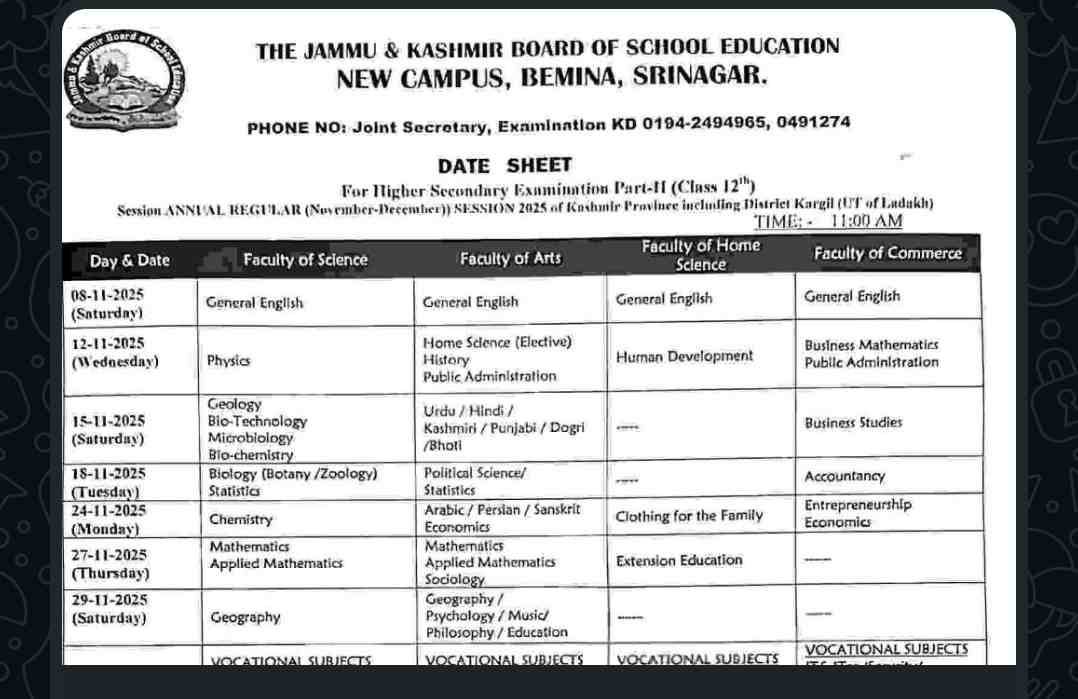
The Jammu and Kashmir Board of School Education (JKBOSE) has officially released the revised Class 12 syllabus for the academic session 2025-26. This comprehensive guide provides detailed information about the updated curriculum, including the significant 15% syllabus reduction for students in Kashmir, Jammu winter zones, and Ladakh divisions. Here complete Step Download JKBOSE Class 12 Syllabus Understanding the JKBOSE Class 12 syllabus is crucial for effective exam preparation and scoring high marks in your board examinations.
With strategic changes implemented to accommodate learning disruptions, the board has carefully curated the syllabus to maintain educational quality while reducing student stress. This article offers a complete breakdown of the JKBOSE Class 12 Syllabus across all streams, marking schemes, important topics, and preparation strategies to help you excel in your JKBOSE Class 12 examinations.
Table of Contents
JKBOSE Class 12 Syllabus 2025-26: Key Highlights
Before delving into subject-wise details, let’s examine the essential features of the updated JKBOSE Class 12 Syllabus:
Aspect Details
Board Name Jammu and Kashmir Board of School Education (JKBOSE)
Class 12th
Academic Year 2025-26
Official Website jkbose.nic.in
Syllabus Status Released
Major Update 15% syllabus reduction for specific regions
Available Streams Science, Commerce, Arts
Syllabus Format Available in PDF for download
Reduction Applicability Kashmir Division, Jammu Winter Zones, Ladakh Division
Detailed Subject-Wise JKBOSE Class 12 Syllabus
Science Stream Syllabus
Physics Syllabus and Marking Scheme
The Physics syllabus for JKBOSE Class 12 Syllabus is designed to build strong conceptual understanding while developing practical application skills. The theory paper carries 70 marks, supplemented by 30 marks for practical assessments.
Unit-wise Distribution:
- Electrostatics (09 Marks)
· Electric Charges and Their Properties
· Coulomb’s Law and Its Application
· Electric Field and Electric Dipole
· Gauss’s Theorem and Applications
· Electric Potential and Potential Energy
· Capacitors and Capacitance - Current Electricity (07 Marks)
· Electric Current and Ohm’s Law
· Electrical Resistance and Resistivity
· Kirchhoff’s Laws and Applications
· Wheatstone Bridge and Potentiometer - Magnetic Effects of Current and Magnetism (09 Marks)
· Magnetic Field and Field Lines
· Biot-Savart Law and Ampere’s Circuital Law
· Magnetic Properties of Materials
· Electromagnetic Induction - Electromagnetic Induction and Alternating Currents (09 Marks)
· Faraday’s Laws and Lenz’s Law
· Self and Mutual Induction
· AC Generator and Transformer
· AC Circuits and Power Factor - Electromagnetic Waves (03 Marks)
· Displacement Current
· Electromagnetic Spectrum and Applications - Optics (14 Marks)
· Reflection and Refraction of Light
· Total Internal Reflection
· Lenses and Mirrors Formula
· Optical Instruments
· Wave Optics and Interference
· Diffraction and Polarization - Dual Nature of Radiation and Matter (04 Marks)
· Photoelectric Effect and Einstein’s Equation
· Matter Waves and de Broglie Hypothesis - Atoms and Nuclei (08 Marks)
· Atomic Models and Their Limitations
· Composition and Size of Nuclei
· Radioactivity and Nuclear Reactions
· Nuclear Energy and Applications - Electronic Devices (07 Marks)
· Semiconductor Materials and Doping
· p-n Junction Diode and Applications
· Junction Transistors and Characteristics
· Digital Electronics and Logic Gates
Practical Syllabus:
· Experiments to determine resistance, impedance, and focal length
· Characteristic curves of diodes and transistors
· Identification of electronic components
· Investigatory project and practical record
Chemistry Syllabus and Marking Scheme
The Chemistry curriculum emphasizes theoretical concepts alongside practical applications, with 70 marks allocated to theory and 30 marks to practical examinations.
Unit-wise Distribution:
- Solutions (07 Marks)
· Types of Solutions and Concentration Terms
· Solubility and Henry’s Law
· Colligative Properties and Abnormal Molecular Mass - Electrochemistry (09 Marks)
· Redox Reactions and Electrochemical Cells
· Conductance and Kohlrausch’s Law
· Batteries and Fuel Cells
· Corrosion and Its Prevention - Chemical Kinetics (07 Marks)
· Rate of Reaction and Factors Affecting It
· Order and Molecularity of Reactions
· Activation Energy and Arrhenius Equation - d and f Block Elements (07 Marks)
· Position in Periodic Table and Electronic Configuration
· Properties and Oxidation States
· Lanthanoids and Actinoids Characteristics - Coordination Compounds (07 Marks)
· Werner’s Theory and Terminology
· Bonding and Stability of Complexes
· Isomerism and Applications - Haloalkanes and Haloarenes (06 Marks)
· Classification and Nomenclature
· Preparation Methods and Physical Properties
· Chemical Reactions and Environmental Effects - Alcohols, Phenols and Ethers (06 Marks)
· Classification and Nomenclature
· Preparation Methods and Properties
· Chemical Reactions and Uses - Aldehydes, Ketones and Carboxylic Acids (08 Marks)
· Nomenclature and Preparation Methods
· Physical Properties and Chemical Reactions
· Mechanism of Nucleophilic Addition - Organic Compounds Containing Nitrogen (06 Marks)
· Amines and Diazonium Salts
· Preparation Methods and Properties
· Chemical Reactions and Importance - Biomolecules (07 Marks)
· Carbohydrates and Their Classification
· Proteins and Enzymes Structure
· Vitamins and Nucleic Acids
· Hormones and Their Functions
Practical Syllabus:
· Volumetric analysis and salt analysis
· Chromatography and preparation of compounds
· Tests for functional groups
· Project work and practical record
Mathematics Syllabus and Marking Scheme
Mathematics focuses on developing analytical and problem-solving skills through comprehensive coverage of various mathematical concepts.
Topic-wise Distribution:
- Relations and Functions (08 Marks)
· Types of Relations and Functions
· Inverse Trigonometric Functions and Properties
· Composition of Functions - Algebra (10 Marks)
· Matrices and Determinants
· Properties and Applications
· Adjoint and Inverse of Matrices - Calculus (35 Marks)
· Continuity and Differentiability
· Applications of Derivatives
· Integrals and Definite Integrals
· Applications of Integrals
· Differential Equations - Vectors and Three-Dimensional Geometry (14 Marks)
· Vectors and Their Properties
· Scalar and Vector Products
· Three-Dimensional Coordinate Geometry
· Lines and Planes in Space - Linear Programming (05 Marks)
· Mathematical Formulation
· Graphical Solution Methods
· Different Types of Problems - Probability (08 Marks)
· Conditional Probability and Multiplication Theorem
· Independent Events and Bayes’ Theorem
· Random Variables and Probability Distributions
· Bernoulli Trials and Binomial Distribution
Commerce Stream Syllabus
Business Studies Syllabus
Business Studies provides fundamental knowledge of business operations and management principles, divided into two parts.
Part A: Principles and Functions of Management (50 Marks)
- Nature and Significance of Management
· Concept and Importance of Management
· Management as Science, Art, and Profession
· Levels and Functions of Management - Principles of Management
· Concept and Significance
· Fayol’s Principles of Management
· Taylor’s Scientific Management - Business Environment
· Concept and Dimensions of Business Environment
· Economic Environment and Economic Policies
· Impact of Government Policies on Business - Planning
· Concept, Importance, and Limitations
· Planning Process and Types of Plans - Organising
· Concept and Importance
· Organisational Structure and Types
· Delegation and Decentralisation - Staffing
· Concept and Importance of Staffing
· Staffing Process and Recruitment
· Selection Process and Training Methods - Directing
· Concept and Importance
· Elements of Directing and Motivation
· Leadership Styles and Communication - Controlling
· Concept and Importance
· Controlling Process and Techniques
Part B: Business Finance and Marketing (30 Marks)
- Business Finance
· Concept and Role of Business Finance
· Financial Planning and Capital Structure
· Fixed and Working Capital - Financial Markets
· Concept and Types of Financial Markets
· Stock Exchange and SEBI Functions
· Trading Procedure and Depository System - Marketing Management
· Concept and Functions of Marketing
· Marketing Mix and Product
· Price, Place, and Promotion
· Consumer Protection and Rights
Economics Syllabus
Economics curriculum covers both micro and macroeconomic principles with practical applications.
Part A: Introductory Microeconomics (40 Marks)
· Consumer Behavior and Demand
· Producer Behavior and Supply
· Forms of Market and Price Determination
· Simple Applications of Demand and Supply
Part B: Introductory Macroeconomics (40 Marks)
· National Income and Related Aggregates
· Money and Banking
· Determination of Income and Employment
· Government Budget and Economy
· Balance of Payments and Foreign Exchange
Part C: Project Work (20 Marks)
· Collection of Primary and Secondary Data
· Analysis and Interpretation of Data
· Project Report Presentation
Arts/Humanities Stream Syllabus
- Political Science Syllabus
Political Science explores political theories, institutions, and international relations.
Contemporary World Politics
· Disintegration of the “Second World” and USSR
· Unipolar World and US Dominance
· Alternative Centers of Power and Regional Organizations
· South Asia in Post-Cold War Era
· International Organizations and Their Role
· Security, Environment, and Globalization
Politics in India Since Independence
· Challenges of Nation-Building
· Era of One-Party Dominance
· Planning and Development
· India’s External Relations
· Democratic Resurgence and Developments
· Regional Aspirations and Social Movements
· Recent Developments in Indian Politics
History Syllabus
History syllabus covers themes in Indian history with focus on understanding historical processes.
Themes in Indian History
· The Story of the First Cities: Harappan Archaeology
· Political and Economic History: How Inscriptions tell a story
· Social Histories: Using the Mahabharata
· A History of Buddhism: Sanchi Stupa
· Medieval Society Through Travellers’ Accounts
· Religious Histories: The Bhakti-Sufi Tradition
· New Architecture: Hampi
· Colonialism and Rural Society: Evidence from Official Reports
· Representations of 1857
· Colonialism and Indian Towns: Town Plans and Municipal Reports
· Mahatma Gandhi Through Contemporary Eyes
· Partition through Oral Sources
· The Making of the Constitution
Language Subjects
English Syllabus
English curriculum focuses on developing language skills through literature and composition.
Books Prescribed:
· Flamingo: Prose and Poetry
· Vistas: Supplementary Reader
Marking Scheme:
· Reading Comprehension: 20 Marks
· Writing Skills and Grammar: 30 Marks
· Literature: 30 Marks
· Internal Assessment: 20 Marks
Section-wise Details:
- Reading Comprehension
· Unseen Passages for Comprehension
· Note-making and Summarizing - Writing Skills
· Advertisement and Notice Writing
· Formal and Informal Letter Writing
· Article and Report Writing
· Speech and Debate Writing - Literature
· Prose and Poetry from Flamingo
· Supplementary Reading from Vistas
· Short Answer and Long Answer Questions
· Value-based Questions
Download JKBOSE Class 12th Syllabus 2024-25 PDF:
Click here to download
JKBOSE Class 12 Syllabus Reduction: Detailed Analysis
The 15% syllabus reduction for 2025 examinations is a significant update that students must understand thoroughly. This reduction applies specifically to students in the Kashmir Division, Jammu Winter Zones, and Ladakh Division.
Key Aspects of Syllabus Reduction:
- Strategic Reduction: The board has removed select topics and chapters while maintaining the core conceptual framework of each subject.
- Continuity Preservation: Despite reductions, the syllabus maintains sequential learning, ensuring students are prepared for higher education.
- Examination Focus: The reduced syllabus will be the sole basis for question paper setting in the 2025 board examinations for applicable regions.
- Subject-Specific Reductions:
· Physics: Selected topics from Optics and Electronic Devices reduced
· Chemistry: Specific organic reactions and coordination compounds topics reduced
· Mathematics: Certain calculus applications and probability topics reduced
· Other Subjects: Proportional reductions across all streams
How to Identify Reduced Portions:
- Refer to official JKBOSE notifications on their website
- Check the revised syllabus PDFs marked with reduction annotations
- Consult with subject teachers for specific deleted topics
- Compare with previous year’s syllabus to identify changes
Downloading JKBOSE Class 12 Syllabus: Step-by-Step Guide
Accessing the official syllabus is straightforward through the JKBOSE portal:
- Visit Official Website: Navigate to jkbose.nic.in
- Locate Student Corner: Find and click on the ‘Student Corner’ section
- Select Syllabus Option: Choose ‘Syllabus’ from the dropdown menu
- Choose Class and Subject: Select Class 12 and your specific subject
- Download PDF: Click to download the syllabus for your reference
Alternatively, students can access subject-wise syllabus through educational portals that provide direct download links.
Preparation Strategy for JKBOSE Class 12 Exams 2025
Effective Study Plan:
- Syllabus Familiarization: Thoroughly review the complete syllabus and marking scheme
- Priority Planning: Identify high-weightage topics and focus areas
- Resource Collection: Gather appropriate textbooks, reference materials, and previous years’ question papers
- Time Management: Create a realistic study schedule with dedicated time slots for each subject
- Revision Strategy: Plan regular revisions to reinforce learning
- Practice Sessions: Solve sample papers and take mock tests regularly
Subject-Specific Preparation Tips:
For Science Subjects:
· Focus on conceptual understanding rather than rote learning
· Practice numerical problems regularly
· Conduct all practical experiments thoroughly
· Create formula sheets for quick revision
For Commerce Subjects:
· Understand concepts with real-world examples
· Practice case studies and application-based questions
· Stay updated with current business developments
· Create mind maps for complex topics
For Arts/Humanities Subjects:
· Develop analytical and critical thinking skills
· Practice answer writing with proper structure
· Relate theoretical concepts to contemporary issues
· Use visual aids like timelines and flowcharts
Utilizing the Syllabus Reduction Advantage:
- Focused Preparation: Concentrate efforts on retained portions of the syllabus
- Depth over Breadth: Explore reduced topics in greater depth
- Time Optimization: Allocate saved time to revision and practice
- Confidence Building: Use the reduced scope to build stronger subject command
Important Resources for JKBOSE Class 12 Preparation
Official Resources:
· JKBOSE official website for syllabus and notifications
· Model question papers and marking schemes
· Practical examination guidelines
Supplementary Resources:
· Recommended textbooks and reference guides
· Online educational platforms for video lessons
· Mobile applications for quick revisions
· Previous years’ question papers for practice
Support Systems:
· Regular consultations with subject teachers
· Peer study groups for collaborative learning
· Parental guidance and support
· Counseling services for stress management
Conclusion: Maximizing Success with JKBOSE Class 12 Syllabus 2025-26
The JKBOSE Class 12 syllabus for 2025-26, with its strategic reductions, presents an opportunity for focused and effective preparation. By understanding the syllabus structure, marking scheme, and examination pattern thoroughly, students can develop a targeted approach to excel in their board examinations.
Remember that consistent effort, strategic planning, and regular revision are key to mastering the curriculum. Utilize the syllabus reduction to deepen your understanding of core concepts rather than reducing your preparation efforts. With proper guidance and dedicated preparation, JKBOSE Class 12 Syllabus students can achieve outstanding results and build a strong foundation for their future academic and professional pursuits.
Stay updated with official JKBOSE notifications for any further changes and approach your preparation with confidence and determination. Success in Class 12 board examinations opens doors to higher education opportunities and sets the stage for a promising career path.
JKBOSE Class 12 Syllabus Download Direct link
Download JKBOSE Class 12th Syllabus 2024-25 PDF:
Click here to download
Link to Download JKBOSE 12th Class Date Sheet 2025 PDF
Download JKBOSE Class 12th Date Sheet 2025 PDF
Frequently Asked Questions (FAQ) – JKBOSE Class 12 Syllabus 2025-26
- Where can I download the official JKBOSE Class 12 syllabus?
· You can download it from the official JKBOSE website: jkbose.nic.in. Go to the ‘Student Corner’ section, select ‘Syllabus’, choose Class 12, and download subject-wise PDFs.
- Is there a syllabus reduction for JKBOSE Class 12 in 2025?
· Yes, JKBOSE has announced a 15% syllabus reduction for students in Kashmir Division, Jammu Winter Zones, and Ladakh Division for the 2025 board exams.
- Which subjects are included in the reduced syllabus?
· The reduction applies to all core subjects—Physics, Chemistry, Mathematics, Biology, Business Studies, Economics, History, Political Science, and Languages. Specific deleted topics are listed in the official syllabus PDFs.
- How is the JKBOSE Class 12 exam structured?
· Exams include:
· Theory Papers: 70-80 marks per subject.
· Practical/Internal Assessment: 20-30 marks (for subjects like Physics, Chemistry, Biology, etc.).
· Project Work: Applicable in Commerce and Arts streams.
- Are practical exams mandatory for Science and Commerce streams?
· Yes, practical exams are mandatory for Science subjects (Physics, Chemistry, Biology) and Commerce subjects like Accountancy. Performance in practicals contributes to the final marks.
- What are the passing criteria for JKBOSE Class 12 exams?
· Students must score at least 33% marks in both theory and practical/project components of each subject to pass.
- Will the reduced syllabus affect my preparation for competitive exams (e.g., JEE, NEET)?
· No. The reduction is specific to JKBOSE Board exams. For competitive exams, you must study the full syllabus prescribed by exam authorities like NTA.
- How do I check which topics are removed in the reduced syllabus?
· Refer to the official JKBOSE syllabus PDFs or consult your teachers. Removed topics are clearly marked in the revised syllabus.
- Is the syllabus the same for Jammu and Kashmir divisions?
· The core syllabus is the same, but the 15% reduction applies only to Kashmir Division, Jammu Winter Zones, and Ladakh.
- What is the best strategy to study the reduced syllabus effectively?
- Focus on high-weightage topics.
- Practice with model papers and previous years’ question papers.
- Revise reduced and retained topics separately for clarity.
- Are NCERT books sufficient for JKBOSE Class 12 preparation?
- Yes, NCERT books are the primary resource. For deeper understanding, you can use reference books like Pradeep’s (Science), RD Sharma (Maths), and Sandeep Garg (Economics).
- When will JKBOSE Class 12 exams 2025 be conducted?
- Tentatively, theory exams are held in March-April 2025, and practical exams in January-February 2025.
- How can I get model test papers for JKBOSE Class 12?
- Model test papers are available on the JKBOSE official website under the “Examination” or “Student” section.
- Is the English syllabus the same for all streams?
- Yes, the English syllabus (books: Flamingo and Vistas) is uniform for Science, Commerce, and Arts streams.
- Can I switch streams after Class 12?
- Your Class 12 stream (Science/Commerce/Arts) determines eligibility for higher education courses. Switching streams may require bridge courses or specific entrance exams.
For more updates, regularly check jkbose.nic.in or consult your school teachers.