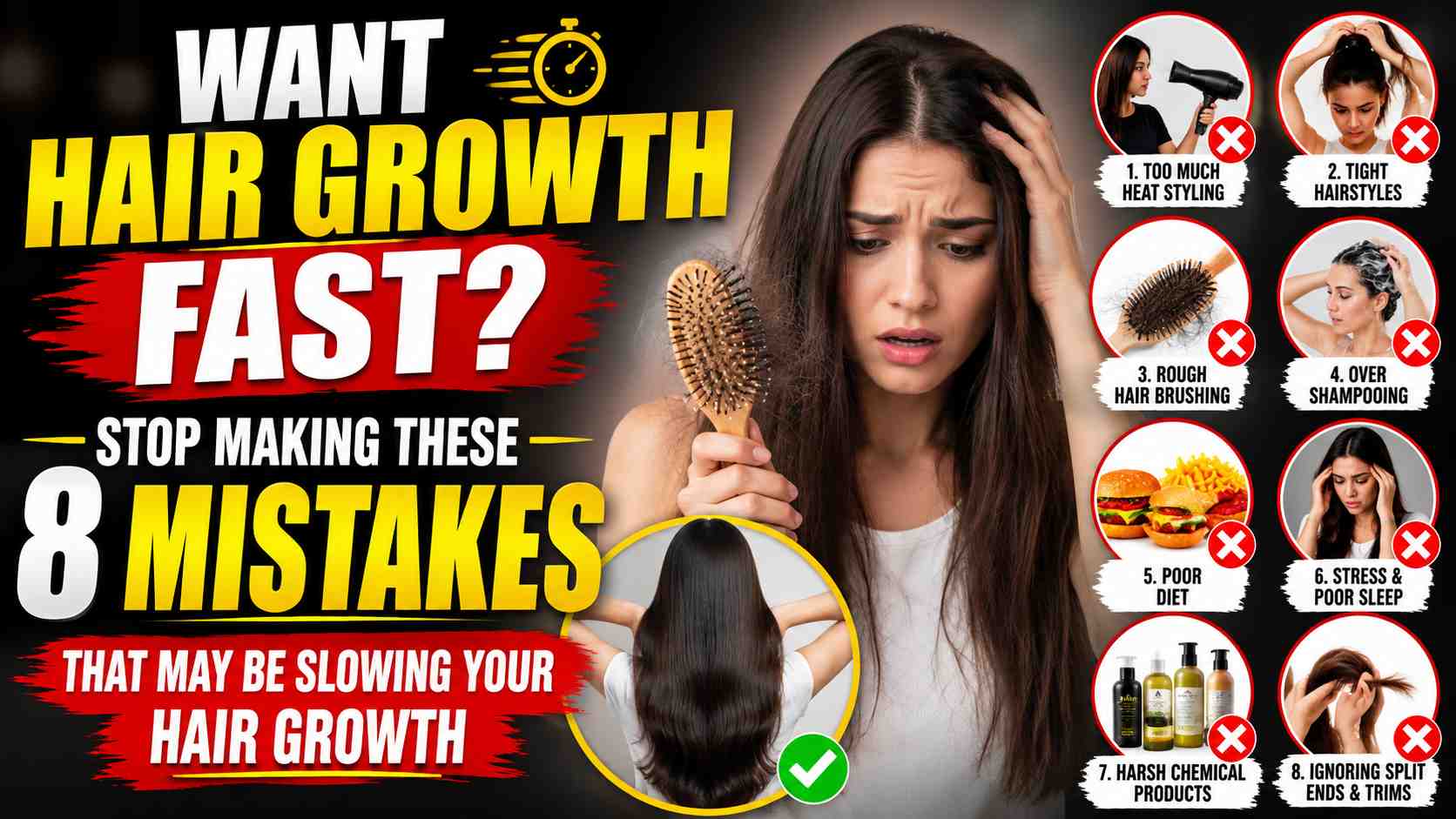
Want Hair Growth Fast? Stop Making These 8 Mistakes That May Be Slowing Your Hair Growth
Introduction
Want hair growth fast? You’re not alone. Many people searching for longer, thicker and healthier hair try everything from hair oils and supplements to special shampoos and home remedies. But while some hair-care habits can support healthy hair, many popular “fast hair growth” claims promise results that simply aren’t realistic.
The truth is that hair growth takes time, and your natural growth rate is influenced by genetics, age, hormones, nutrition, overall health and the hair-growth cycle. There is no guaranteed method that can make your hair grow dramatically overnight. However, you can take practical steps to support normal hair growth, reduce hair breakage and improve your ability to retain length.
Want Hair Growth Fast?Sometimes the problem isn’t that your hair isn’t growing. Your hair may be growing normally from the scalp while the ends are breaking because of excessive heat, chemical treatments, rough brushing or tight hairstyles. In other cases, persistent shedding or thinning may have an underlying cause that needs professional attention.
That’s why knowing what not to do is just as important as knowing what to do for hair growth.
In this guide, we’ll look at 8 common mistakes that may be working against your hair-growth goals, along with practical ways to protect your hair, support scalp health, improve length retention and recognize when persistent hair loss may require professional evaluation.
How to Lose Belly Fat: A Science-Based Guide to a Slimmer, Healthier Waist
20 High-Protein Vegetarian Foods to Add to Your Diet
15 Easy High-Protein Foods to Add to Your Diet: Breakfast, Snacks & Meals
If you want hair growth fast, start by avoiding these common mistakes and building a consistent hair-care routine that supports healthier, stronger hair over time
Want Hair Growth Fast? What Actually Works
Before discussing the mistakes, it is important to understand what “fast hair growth” actually means.
Hair grows from follicles located beneath the skin of the scalp. The follicle produces a hair shaft through a cycle that includes periods of active growth, transition and resting. The length of time your hair remains in the growth phase varies from person to person.
This means that genetics plays an important role in determining how quickly your hair grows and how long it can become.
For most people, the practical goal should not be to force hair to grow unnaturally fast. Instead, the goal is to create the best conditions for normal hair growth while reducing breakage and preventable hair loss.
For example, someone may believe their hair is “not growing” because the ends repeatedly break. Their scalp may actually be producing new hair normally, but the visible length does not increase because the hair shaft is being damaged.
That is why proper nutrition, gentle hair care and attention to scalp health matter.
Now let’s look at eight mistakes that may be working against your goal.
1. Not Eating Enough Protein
One of the most overlooked factors in hair health is nutrition.
Hair is primarily composed of a protein called keratin. Your body needs adequate protein and other nutrients to support normal biological functions, including the production of hair.
If your diet consistently contains too little protein, your body may not have an adequate supply of the building blocks required for normal tissue maintenance.
This does not mean that eating huge amounts of protein will suddenly make your hair grow faster. More is not always better. The important point is to consume an adequate, balanced diet.
Good sources of protein include:
- Eggs
- Fish
- Chicken
- Milk
- Yogurt and curd
- Cheese
- Lentils
- Beans
- Chickpeas
- Soy products
- Nuts and seeds
A balanced meal can combine protein with vegetables, whole grains or other sources of carbohydrates and healthy fats.
People who follow restrictive diets should pay particular attention to whether they are getting adequate protein and other essential nutrients.
What if you eat plenty of protein?
If your protein intake is already adequate, increasing it dramatically is unlikely to provide an extra hair-growth benefit by itself.
Hair health depends on many factors, not one nutrient.
The better strategy is to maintain a varied diet that provides sufficient protein, vitamins, minerals and calories.
2. Ignoring Possible Nutrient Deficiencies
Another common mistake is ignoring nutrition completely while looking for a miracle hair-growth product.
Certain nutritional deficiencies can be associated with hair loss. Depending on the individual, these may include deficiencies involving nutrients such as iron, zinc, vitamin D or vitamin B12.
However, this does not mean everyone experiencing hair loss should automatically take supplements.
Taking a supplement when you do not have a deficiency may not solve the problem, and excessive intake of certain nutrients can cause problems.
Iron deserves special attention
Iron deficiency can contribute to hair loss in some people. People with increased nutritional needs or certain dietary patterns may be more vulnerable.
If you have persistent hair shedding, fatigue or other symptoms that concern you, a healthcare professional can determine whether testing is appropriate.
Vitamin D and hair health
Vitamin D is involved in several processes in the body, and researchers have investigated its relationship with hair disorders. However, taking vitamin D simply because you want faster hair growth is not a guaranteed treatment.
If a deficiency is present, correcting it may be important for overall health and potentially for hair health.
Vitamin B12
Vitamin B12 is another nutrient that deserves attention, particularly in people whose diets or health conditions put them at risk of deficiency.
Again, the correct approach is not to assume that every hair problem is caused by B12 deficiency.
The important lesson
Do not treat hair loss by taking a large collection of supplements without understanding the cause.
A balanced diet is the foundation. If you have significant or persistent hair loss, discussing your symptoms and possible testing with a healthcare professional is a better approach.
3. Using Too Much Heat on Your Hair
Heat styling can make hair look attractive temporarily, but excessive heat can damage the hair shaft.
Straighteners, curling irons, hot brushes and frequent high-temperature blow-drying can contribute to dryness and structural damage.
Damaged hair becomes more vulnerable to breakage and split ends.
This is particularly important for people who believe their hair is growing slowly. If the roots are producing hair normally but the ends continually break, you may struggle to retain length.
Common heat-related mistakes include:
- Using a straightener every day
- Applying very high temperatures
- Repeatedly passing a hot tool over the same section
- Blow-drying extremely wet hair with excessive heat
- Using heat without considering the condition of the hair
You do not necessarily have to eliminate heat styling completely.
Instead, reduce unnecessary exposure.
Better habits
Allow your hair to partially air-dry when practical. Use a lower heat setting and avoid keeping a hot tool on one section for too long.
If you use heat frequently, consider products designed to reduce heat-related damage.
The goal is not simply to make hair grow from the scalp faster. It is also to protect the length you already have.
4. Being Too Rough With Wet Hair
Wet hair can be more vulnerable to stretching and mechanical damage.
One common mistake is vigorously rubbing freshly washed hair with a towel.
Another is aggressively brushing or combing tangled, wet hair.
Repeated mechanical stress can contribute to breakage.
Instead, try these habits:
- Gently squeeze excess water from your hair.
- Avoid aggressively rubbing your scalp and hair with a towel.
- Detangle carefully.
- Start working through tangles from the ends and gradually move upward.
- Use a suitable wide-tooth comb if it works well for your hair type.
- Avoid unnecessary pulling.
Small changes in how you handle your hair can make a meaningful difference in reducing breakage.
Why breakage matters for hair growth
Imagine your hair grows normally from the scalp, but the ends keep snapping.
You may look in the mirror after several months and feel that your hair has barely grown.
The problem may not be the growth rate itself.
It may be poor length retention.
This is why “faster hair growth” and “less hair breakage” are not exactly the same thing.
5. Wearing Very Tight Hairstyles Too Often
Tight hairstyles can place repeated tension on the hair and scalp.
Examples include very tight ponytails, buns, braids and other styles that continuously pull the same areas.
Repeated tension can contribute to a type of hair loss called traction alopecia.
Early traction-related hair loss may be easier to address than long-standing damage, which is why paying attention to warning signs is important.
Want Hair Growth Fast?Signs that your hairstyle may be too tight include:
- Scalp tenderness after tying your hair
- Headaches after wearing a hairstyle
- Small broken hairs around the hairline
- Receding edges
- Thinning in areas exposed to repeated tension
- Redness or irritation
If a hairstyle hurts, it is generally a good reason to loosen it.
You can still wear your favorite hairstyle, but try varying styles and reducing constant tension.
Give your hair a break
Avoid putting strong tension on exactly the same areas every day.
Changing the position of a ponytail or bun and choosing looser styles can reduce repeated stress.
This is particularly important for people who already notice thinning around the temples or hairline.
6. Ignoring Your Scalp
Many people focus almost entirely on the hair shaft and forget that hair grows from the scalp.
A healthy scalp is an important part of good hair care.
Problems such as persistent dandruff, inflammation, itching or excessive oiliness can make the scalp uncomfortable and may sometimes be associated with hair shedding.
This does not mean that every scalp problem causes permanent hair loss. It means persistent symptoms should not simply be ignored.
Pay attention to symptoms such as:
- Persistent itching
- Severe flaking
- Redness
- Scalp pain
- Crusting
- Sores
- Sudden changes in scalp condition
- Unusual or rapidly increasing hair shedding
If these symptoms continue, a dermatologist can help determine the underlying cause.
Does washing hair cause hair loss?
Many people become worried when they see hair strands in the shower.
However, washing itself does not necessarily mean that the shampoo is causing hair loss.
Some hairs naturally enter the shedding phase and become noticeable during washing or brushing.
The important thing is to look at the overall pattern rather than panic over a handful of hairs seen on one day.
Choose hair products based on your needs
There is no single shampoo that works perfectly for everyone.
A product that suits one person’s scalp may irritate another person’s.
If a particular product consistently causes burning, itching or irritation, consider stopping it and seeking professional advice if symptoms continue.
7. Expecting Oils and Home Remedies to Work Overnight
Hair oils have become extremely popular because they are simple, affordable and easy to use.
Coconut oil, rosemary oil, castor oil and other oils are frequently promoted online as powerful hair-growth solutions.
Some oils can be useful for conditioning hair, reducing dryness or improving the feel and appearance of the hair.
But there is an important difference between conditioning the hair and dramatically increasing follicle growth.
No oil should automatically be considered a miracle hair-growth treatment.
What about rosemary oil?
Rosemary oil has received attention because some research has investigated its potential role in hair growth. However, evidence is still more limited than the marketing surrounding it often suggests.
It should not be presented as a guaranteed way to rapidly regrow hair.
Essential oils can also irritate the scalp if used improperly or at excessive concentrations.
If you choose to use an essential oil, it should be appropriately diluted and stopped if irritation develops.
What about castor oil?
Castor oil is often promoted online as a way to make hair grow extremely quickly.
However, there is not strong evidence that simply applying castor oil to the scalp dramatically increases the rate of hair growth.
It can make hair feel coated and moisturized, but that should not be confused with proven follicle stimulation.
The same applies to many DIY remedies
Onion juice, garlic, various herbal mixtures and other homemade treatments are frequently recommended online.
Some may have preliminary research or traditional use behind them, but that does not make them guaranteed treatments for hair loss.
Some can also irritate the scalp.
If your hair loss is significant, don’t allow a home remedy to delay proper evaluation.
8. Ignoring Persistent or Sudden Hair Loss
This may be the most important mistake on the list.
If you have persistent hair loss, rapidly increasing shedding or noticeable thinning, simply buying another shampoo may not address the real problem.
Hair loss has many possible causes.
Some forms are strongly influenced by genetics. Others can be associated with hormonal changes, nutritional problems, certain illnesses, medications, stress or scalp disorders.
Common patterns can look different
Some people notice gradual thinning around the temples and crown.
Others experience diffuse shedding across the scalp.
Some develop clearly defined patches.
The pattern and timing can provide important clues about the underlying cause.
When should you seek professional advice?
Consider speaking with a healthcare professional or dermatologist if you notice:
- Sudden or severe hair shedding
- Rapidly developing bald patches
- Significant thinning
- Receding hairline
- Scalp pain or inflammation
- Persistent itching or scaling
- Hair loss accompanied by other concerning symptoms
- Hair loss that continues without an obvious explanation
Getting the cause identified can be much more useful than trying random treatments.
Hair Growth Fast: What Actually Helps?
Once you stop making common mistakes, the next question is obvious:
What should you actually do?
There is no universal overnight solution, but several habits can support healthier hair and better length retention.
Eat a Balanced Diet
Instead of focusing on one “hair-growth food,” eat a wide variety of nutritious foods.
Include:
- Adequate protein
- Vegetables
- Fruits
- Whole grains
- Legumes
- Dairy or suitable alternatives
- Nuts and seeds
- Healthy sources of fats
A balanced diet provides many nutrients that your body needs for normal function.
Get Enough Protein
Protein is important for hair structure and overall health.
Spread protein-containing foods throughout your meals rather than relying on one food alone.
Eggs, fish, poultry, dairy, lentils, beans and soy products are practical options.
Avoid Crash Diets
Rapid weight-loss diets can dramatically reduce calorie and nutrient intake.
For some people, significant physical stress or nutritional restriction can be followed by increased hair shedding.
If you want to lose weight, a sustainable approach is generally better than extreme restriction.
Protect Your Hair From Damage
If your goal is long hair, protecting your existing hair is essential.
Reduce:
- Excessive heat
- Aggressive brushing
- Tight hairstyles
- Frequent harsh chemical treatments
- Unnecessary manipulation
Remember: length retention is a major part of achieving longer hair.
Take Care of Your Scalp
Keep your scalp clean according to your hair and scalp needs.
Do not automatically avoid shampoo because you believe washing causes hair loss.
If you have persistent dandruff, itching or inflammation, consider getting professional advice.
Be Careful With Supplements
The internet is full of hair-growth supplements promising dramatic results.
But supplements are not automatically harmless.
Taking excessive amounts of some vitamins and minerals can actually cause health problems, and some supplements may interact with medications.
Supplements are most useful when there is a genuine nutritional need or when recommended by a qualified professional.
Does Cutting Your Hair Make It Grow Faster?
This is one of the most common hair myths.
Cutting the ends does not make hair follicles produce hair faster.
Hair grows from the follicle beneath the scalp, not from the ends.
However, trimming damaged ends can make hair look healthier and may reduce the appearance of split ends.
So trimming can help with appearance and manageability, but it does not increase the biological growth rate of the follicle.
Does Washing Hair Every Day Stop Hair Growth?
Not necessarily.
How frequently you should wash your hair depends on your scalp, hair type, activity level, oil production and personal needs.
Some people need frequent washing because their scalp becomes oily quickly. Others can go longer between washes.
The key is using a suitable product and avoiding excessive irritation.
If you notice persistent scalp problems, ask a dermatologist for personalized advice.
Does Scalp Massage Help Hair Growth?
Scalp massage can feel relaxing and may temporarily improve the feeling of circulation in the scalp.
Some small studies have investigated whether regular scalp massage could influence hair thickness, but the evidence is not strong enough to call it a guaranteed hair-growth treatment.
If you enjoy scalp massage, it can be included as part of a gentle hair-care routine.
Avoid aggressive scratching or pulling.
Can Stress Affect Hair?
Stress can affect the body in many ways, and significant physical or emotional stress can sometimes be followed by increased hair shedding.
This type of shedding may occur after a delay, meaning the hair loss may not happen immediately after the stressful event.
Stress is not the explanation for every case of hair loss, but managing sleep, nutrition, physical activity and overall wellbeing is beneficial for general health.
If substantial shedding continues, don’t automatically assume stress is the only cause.
How Long Does Hair Take to Grow?
Hair growth is gradual.
The exact rate varies among individuals, and genetics, age, health and other factors can influence it.
This is why claims promising dramatically longer hair within a few days should be treated with skepticism.
Instead of checking your hair every morning for visible growth, take a longer-term approach.
Take occasional photographs under similar lighting and compare them over several months if you want to monitor changes.
Hair Growth vs. Hair Retention: What’s the Difference?
This distinction can completely change how you approach your hair-care routine.
Hair growth
This refers to the production of new hair from the follicle.
Hair retention
This refers to keeping the hair you have already grown without excessive breakage.
For example, imagine someone has normal growth but frequently uses high heat, chemically processes their hair and brushes aggressively.
Their hair may grow from the scalp, but the ends repeatedly break.
The person may conclude:
“My hair doesn’t grow.”
In reality, they may have a length-retention problem.
This is why reducing damage can make your hair appear to grow faster even when the follicle’s growth rate has not dramatically changed.
8 Mistakes to Remember
If you want to remember the entire article quickly, keep these eight mistakes in mind:
1. Not eating enough protein
Your hair needs adequate nutrition to support normal growth and maintenance.
2. Ignoring possible nutrient deficiencies
Iron, vitamin D, B12 and other nutrients can matter when a genuine deficiency exists.
3. Excessive heat styling
High heat can damage the hair shaft and increase breakage.
4. Rough handling of wet hair
Wet hair can be more vulnerable to mechanical damage.
5. Wearing tight hairstyles constantly
Repeated tension can contribute to traction-related hair loss.
6. Ignoring scalp problems
Persistent itching, inflammation or scaling should not simply be ignored.
7. Expecting oils and home remedies to work overnight
Natural does not automatically mean proven or risk-free.
8. Ignoring persistent hair loss
Finding the underlying cause is more important than continually trying random products.
A Simple Hair-Growth-Friendly Daily Routine
You do not need a complicated 20-step routine.
A simple approach can be more sustainable.
Morning
Eat a nutritious breakfast containing a source of protein.
Drink enough fluids according to your body’s needs.
Avoid unnecessarily tight hairstyles.
During the day
Eat balanced meals.
Include protein-rich foods and a variety of fruits and vegetables.
Avoid excessive heat styling.
Try not to repeatedly pull, twist or manipulate your hair.
After washing
Handle wet hair gently.
Avoid vigorous towel rubbing.
Detangle carefully.
Use heat only when necessary.
Evening
If you use hair products, follow their directions rather than applying excessive amounts.
If you massage your scalp, keep the pressure gentle.
Get adequate sleep and maintain a consistent routine.
Foods That Support Overall Hair Health
No food can guarantee rapid hair growth, but a nutrient-rich diet supports normal body functions.
Some useful choices include:
Eggs
Eggs provide protein and several nutrients.
Fish
Fish can provide protein and, depending on the type, beneficial fats and other nutrients.
Lentils and beans
These are useful plant-based sources of protein and several micronutrients.
Dairy products
Milk, yogurt and other dairy foods can contribute protein and nutrients to the diet.
Nuts and seeds
Nuts and seeds provide healthy fats, protein and various minerals.
Fruits and vegetables
A wide variety of fruits and vegetables helps provide vitamins, minerals, antioxidants and fiber.
The key is variety rather than relying on one “superfood.”
Be Careful With Viral Hair-Growth Claims
Social media has created a huge market for hair-growth advice.
One week it may be rice water.
Another week it may be onion juice.
Then rosemary oil, a particular supplement or an expensive shampoo becomes the latest trend.
Some ingredients may have limited evidence behind them, but online popularity does not equal scientific proof.
Before trying a viral treatment, ask:
Does good evidence support this claim?
Could it irritate my scalp?
Am I ignoring a possible underlying medical cause?
Is the product making unrealistic promises?
A product claiming to produce dramatic hair growth within days should immediately make you skeptical.
When Hair Loss May Need Medical Evaluation
Not every case of hair loss requires medical treatment.
Normal shedding occurs as part of the hair cycle.
However, persistent or significant changes deserve attention.
A dermatologist can examine the scalp, assess the pattern of hair loss and determine whether additional testing is appropriate.
Depending on the situation, the evaluation may consider family history, medications, recent illness, nutritional status, hormonal factors and other possible causes.
The earlier some causes are identified, the more options may be available.
Final Thoughts: Want Hair Growth Fast? Start With the Basics
If you want hair growth fast, the first step is not necessarily buying another expensive hair-growth product.
Start by eliminating the habits that may be damaging your hair.
Eat a balanced diet with adequate protein. Avoid extreme dieting. Protect your hair from excessive heat and mechanical damage. Avoid constantly tight hairstyles. Look after your scalp. Be skeptical of miracle oils and supplements. And most importantly, don’t ignore persistent or sudden hair loss.
You cannot completely control your hair-growth rate because genetics and other biological factors play a major role.
But you can control many of the habits that influence hair health and breakage.
The goal should be simple:
Support normal growth. Protect the hair you already have. Identify problems early. Be consistent.
Healthy hair growth takes time, so don’t judge your results after a few days. Give your routine time, monitor changes over the longer term and seek professional advice if you experience significant or unexplained hair loss.
Frequently Asked Questions
What is the fastest way to grow hair naturally?
There is no guaranteed natural method that can dramatically speed up hair growth within days. The best approach is to support normal growth through adequate nutrition, gentle hair care, scalp health and treatment of any underlying problem.
Which food is best for hair growth?
There is no single best food for hair growth. A balanced diet containing adequate protein, fruits, vegetables, whole grains, legumes, dairy or alternatives, nuts and seeds is more useful than relying on one food.
Can eggs help hair growth?
Eggs provide protein and several nutrients that contribute to a balanced diet. Adequate protein is important for normal hair structure, but eating eggs alone cannot guarantee faster hair growth.
Does oil make hair grow faster?
Some oils can condition hair and help reduce dryness or breakage, but most should not be considered guaranteed treatments for rapid hair growth. Evidence varies significantly between different oils.
How can I make my hair thicker?
Hair thickness depends partly on genetics and the underlying cause of thinning. Protecting hair from breakage, maintaining good nutrition and addressing medical causes of hair loss can help improve the overall appearance and health of your hair.
Does cutting hair increase growth?
No. Cutting the ends does not make the follicles produce hair faster. Trimming can remove damaged ends and improve appearance, but it does not increase the biological rate of growth.
Why is my hair not getting longer?
Your hair may be growing normally but breaking at the same time. Excessive heat, chemical processing, rough brushing and other forms of damage can reduce length retention.
When should I see a dermatologist for hair loss?
Consider professional evaluation if hair loss is sudden, severe, persistent, patchy or accompanied by scalp symptoms such as pain, redness, significant itching or scaling.
Can stress cause hair loss?
Significant physical or emotional stress can be associated with increased hair shedding in some people. However, hair loss has many possible causes, so persistent shedding should not automatically be blamed on stress.
Is faster hair growth possible in one week?
A dramatic increase in hair length within one week is not realistic for most people. Be cautious with products or social-media claims promising dramatic growth in a few days.
More Things You Should Know About Faster, Healthier Hair Growth
Understanding hair growth is important because many people make decisions based on myths rather than how the hair cycle actually works. If you want longer and healthier hair, it helps to separate realistic expectations from exaggerated claims.
Your Hair Growth Rate Is Not Completely Under Your Control
One of the biggest misconceptions about hair growth is that everyone can achieve the same growth rate by following the same routine.
Hair growth is influenced by several factors, including genetics, age, hormones, overall health and the natural hair-growth cycle.
Two people can follow almost identical hair-care routines and still experience different results.
One person may naturally grow hair relatively quickly, while another may have a slower growth pattern.
This does not necessarily mean that one person is doing something wrong.
The goal of a good hair-care routine is therefore not to force your follicles to behave differently overnight. Instead, it is to support normal hair growth and prevent avoidable damage and breakage.
Genetics Plays a Major Role
Your genes influence many characteristics of your hair, including its texture, density, growth pattern and how long the growth phase lasts.
This is one reason why some people seem to grow very long hair effortlessly while others struggle to retain length.
Genetics can also influence the likelihood of certain forms of hair thinning.
If close family members have experienced progressive hair loss, it may be worth paying attention to early changes rather than waiting until significant thinning develops.
Genetics cannot be changed through shampoo or hair oil, but identifying hereditary hair loss early may allow appropriate treatment options to be considered.
Don’t Confuse Hair Thickness With Hair Growth
Another important distinction is the difference between hair growth, hair thickness and hair density.
Hair growth refers to how the hair shaft grows from the follicle.
Hair thickness refers to the diameter of individual strands.
Hair density refers broadly to how many hairs are present in a particular area.
A product may make hair feel thicker or more voluminous without actually increasing the number of follicles.
Likewise, reducing breakage can make hair appear fuller even if the number of follicles has not changed.
Understanding this can help you avoid misleading marketing.
Be Careful With “100% Natural” Claims
Natural products can sound safer and more effective simply because they are described as natural.
But natural does not automatically mean harmless.
Essential oils, concentrated plant extracts and homemade mixtures can cause irritation or allergic reactions in some people.
For example, applying an undiluted essential oil directly to the scalp may cause irritation.
If you experience burning, swelling, severe itching or a rash after using a product, stop using it.
If symptoms are severe or persistent, seek medical advice.
Avoid Constantly Changing Your Hair Routine
Another mistake is changing products every few days because you haven’t noticed immediate results.
Hair growth is slow, so repeatedly switching shampoos, oils and treatments can make it difficult to determine what actually works for you.
A simple routine is often easier to maintain.
Choose products appropriate for your scalp and hair type, use them consistently and evaluate your hair over a reasonable period.
If a product causes irritation, however, you do not need to continue using it simply because you want to give it more time.
Don’t Scratch Your Scalp Aggressively
If your scalp feels itchy, aggressively scratching it may provide temporary relief but can also damage the skin.
Repeated scratching can create irritation and may worsen certain scalp conditions.
Instead of simply trying to cover the symptom with oils or home remedies, consider why the scalp is itchy.
Dandruff, dryness, irritation, allergies and several other conditions can cause scalp itching.
Persistent symptoms deserve proper attention.
Avoid Excessive Chemical Processing
Hair coloring, bleaching, straightening and other chemical treatments can alter the structure of the hair.
Frequent or aggressive chemical processing may increase dryness and breakage.
If you color or chemically treat your hair, allow adequate time between treatments and follow product instructions carefully.
Protecting the hair shaft is particularly important if your main goal is to grow your hair longer.
Again, the issue is often not that the follicle suddenly stopped growing.
The problem may be that the hair being produced is repeatedly damaged before you can retain much length.
Don’t Sleep With Extremely Wet Hair
Going to bed with wet hair does not automatically cause permanent hair loss.
However, wet hair can be more vulnerable to mechanical damage, particularly when you move around during sleep.
If your hair is long or easily tangled, allowing it to dry partially before bed and handling it gently may reduce unnecessary breakage.
Avoid tightly tying wet hair.
Choose a Comfortable Pillow and Sleeping Routine
Hair rubbing against bedding can contribute to tangling and breakage, particularly for fragile or textured hair.
Some people prefer smoother pillowcase fabrics because they may reduce friction.
However, you do not need an expensive pillowcase to have healthy hair.
More important habits include avoiding tight hairstyles while sleeping, reducing unnecessary friction and keeping your hair in a comfortable position.
Don’t Believe Every Hair-Growth Supplement Advertisement
Hair supplements are heavily marketed online.
Some advertisements imply that one capsule can dramatically transform thinning hair.
This is an oversimplification.
Supplements may be useful when a person has a genuine deficiency or a specific nutritional requirement, but taking more nutrients than necessary does not automatically produce faster hair growth.
In some situations, excessive intake of certain nutrients can even be harmful.
Before starting a high-dose supplement, consider whether you actually need it.
Biotin Is Not a Miracle Hair-Growth Vitamin
Biotin is frequently promoted as the ultimate hair-growth supplement.
Biotin is an important nutrient, but severe biotin deficiency is uncommon in many people.
If you already have adequate biotin intake, taking large doses does not necessarily mean your hair will suddenly grow faster.
This is an important example of why nutritional supplements should not be treated as magic solutions.
If hair loss is significant, identifying the cause is more useful than automatically taking biotin.
Don’t Ignore Your Overall Health
Your hair does not exist separately from the rest of your body.
Poor nutrition, major illness, significant weight changes and other forms of physical stress can sometimes affect the hair cycle.
That is why maintaining overall health is part of maintaining healthy hair.
Regular physical activity, balanced nutrition, adequate sleep and appropriate management of health conditions all contribute to general wellbeing.
Sleep May Matter More Than You Think
Sleep is often ignored in discussions about hair.
While sleeping longer is not a guaranteed hair-growth treatment, adequate sleep supports normal body functions and overall health.
Instead of looking for a special “hair-growth sleeping position,” focus on maintaining a regular sleep schedule and getting sufficient rest.
Don’t Compare Your Hair With Social Media
Social media can create unrealistic expectations.
Many hair-growth videos show dramatic transformations within a few weeks.
But photographs can be affected by:
- Lighting
- Hair styling
- Camera angles
- Hair extensions
- Different hairstyles
- Editing
- Different hair lengths
- Changes in hair volume
A transformation video is not necessarily evidence that a particular product caused the result.
If you want to monitor your own progress, take photographs under similar lighting and from similar angles.
Hair Growth Takes Patience
Perhaps the most important advice is simple:
Give your routine time.
Hair grows slowly, and meaningful changes are usually measured over months rather than days.
Checking your hair repeatedly can make normal growth feel invisible.
Instead, focus on consistency.
Eat well.
Protect your hair.
Take care of your scalp.
Avoid unnecessary damage.
Address unusual hair loss.
Then evaluate your progress over a longer period.
What Should You Do If You Notice Hair Thinning?
The first step is to avoid panicking.
Hair thinning can have many causes, and not all of them mean permanent baldness.
Look at the pattern.
Is your hairline changing?
Is the crown becoming thinner?
Are you losing hair evenly across the scalp?
Are there clearly defined bald patches?
Are you experiencing scalp irritation?
Has the shedding started suddenly?
These details can help a healthcare professional understand what may be happening.
Don’t Wait Too Long With Progressive Hair Loss
If you notice gradual but continuing thinning, waiting indefinitely while trying different oils may not be the best strategy.
Some forms of hair loss are progressive.
A dermatologist can determine whether the pattern is consistent with a particular condition and discuss evidence-based options.
The earlier a problem is recognized, the more informed your treatment decisions can be.
Hair Care Should Be Personalized
There is no single routine that works perfectly for every person.
A person with an oily scalp may need a different washing routine from someone with a dry scalp.
Someone with curly or textured hair may have different detangling needs from someone with straight hair.
Someone with chemically treated hair may require additional protection from breakage.
This is why copying another person’s exact routine is not always useful.
Instead, identify what your own hair and scalp actually need.
A Simple Weekly Hair-Care Checklist
Use this checklist to keep your routine simple.
Nutrition
Ask yourself:
- Am I eating enough protein?
- Am I eating a variety of foods?
- Am I avoiding extreme diets?
- Am I getting enough fruits and vegetables?
Hair handling
Ask:
- Am I using excessive heat?
- Do I brush aggressively?
- Do I pull or tug at tangles?
- Do I frequently wear very tight hairstyles?
Scalp
Check:
- Is my scalp persistently itchy?
- Do I have significant dandruff?
- Is there redness or irritation?
- Have I noticed unusual changes?
Hair loss
Ask:
- Is shedding increasing?
- Is my hair becoming visibly thinner?
- Are there bald patches?
- Is my hairline changing?
If something seems unusual or continues to worsen, professional evaluation may be worthwhile.
The Biggest Hair-Growth Mistakes in One Sentence
If you want to remember everything from this article, remember this:
Don’t starve your body, don’t repeatedly damage your hair, don’t constantly pull on your scalp, don’t ignore scalp problems, don’t blindly take supplements, and don’t delay evaluation of persistent hair loss.
A Realistic Hair-Growth Plan
Instead of promising yourself that your hair will transform in one week, create a realistic long-term plan.
Step 1: Improve your diet
Make sure your meals provide adequate protein and a variety of nutrients.
Step 2: Reduce damage
Limit unnecessary heat, harsh chemical processing and aggressive brushing.
Step 3: Protect your scalp
Keep your scalp comfortable and clean according to your individual needs.
Step 4: Reduce tension
Avoid hairstyles that constantly pull on the same areas.
Step 5: Avoid miracle claims
Be skeptical of products promising dramatic growth within days.
Step 6: Monitor changes
Take occasional photographs rather than checking your hair constantly.
Step 7: Investigate persistent hair loss
If thinning or shedding continues, consider professional evaluation.
Final Conclusion
Wanting faster hair growth is completely understandable, especially when you’re dealing with thinning hair or trying to grow your hair longer.
But the most effective approach is usually not a single miracle ingredient.
Healthy hair depends on a combination of factors.
Your genetics determine much of your natural growth pattern. Your nutrition provides the building blocks your body needs. Your scalp provides the environment where follicles produce hair. Your daily habits determine how much damage your hair experiences. And your overall health can influence the hair-growth cycle.
That means your strategy should be broader than simply asking:
“What oil will make my hair grow faster?”
A better question is:
“What can I do to support healthy hair growth and prevent unnecessary hair loss and breakage?”
The answer begins with the basics.
Eat a balanced diet.
Get adequate protein.
Avoid extreme dieting.
Handle your hair gently.
Limit excessive heat.
Avoid constant tension.
Pay attention to scalp health.
Don’t take unnecessary high-dose supplements.
And don’t ignore persistent or sudden hair loss.
Most importantly, remember that healthy hair growth takes time.
There is no credible shortcut that can turn a few days of growth into months of growth overnight. Be cautious about dramatic before-and-after claims and products that promise unrealistic results.
If your hair is healthy and your follicles are functioning normally, your job is largely to support the natural process and protect the hair you grow.
If something is interfering with that process, identifying the cause is more important than repeatedly changing products.
What Else Can Affect Hair Growth and Hair Thickness?
Hair growth is a complicated biological process, so focusing on shampoo, oil or one particular food can sometimes cause people to overlook other important factors.
If you are doing everything correctly but still experiencing noticeable thinning or excessive shedding, there may be another reason that needs attention.
1. Hormonal Changes Can Affect Hair
Hormones play an important role in hair growth.
Changes in hormone levels can affect the hair-growth cycle and may contribute to increased shedding or thinning in some people.
Hormonal changes can occur for many reasons, including normal life stages, certain medical conditions and some medications.
For this reason, persistent unexplained hair loss should not always be treated as a simple hair-care problem.
If your hair suddenly changes significantly, a healthcare professional can help determine whether hormonal or other factors could be involved.
2. Family History Matters
Take a look at your family’s hair-loss history.
If parents, grandparents or siblings have experienced a similar pattern of hair thinning, genetics may play a role.
Genetic hair loss can develop gradually, sometimes beginning with subtle changes that are easy to overlook.
Men may notice changes around the temples or crown, while women can experience more diffuse thinning.
A family history does not guarantee that you will develop the same pattern, but it is useful information when evaluating hair loss.
3. Major Weight Loss Can Influence Hair Shedding
Rapid or significant weight loss can place stress on the body.
When calorie and nutrient intake drops substantially, some people may experience increased hair shedding.
This is one reason extreme diets and crash dieting are not ideal strategies for either health or hair.
If you are trying to lose weight, aim for a sustainable approach that provides adequate nutrition rather than drastically restricting food.
4. Illness Can Temporarily Affect the Hair Cycle
Some people notice increased hair shedding after a significant illness.
The interesting part is that the shedding may not appear immediately.
Because hair follicles operate through a cycle, changes can sometimes become noticeable weeks or months after the triggering event.
This can make it difficult to connect the shedding with what happened earlier.
If you recently experienced a significant illness and later noticed increased shedding, mention this history when speaking with a healthcare professional.
5. Certain Medications May Affect Hair
Some medications can be associated with hair changes in certain people.
This does not mean you should stop prescribed medication because you are experiencing hair loss.
Never discontinue a prescribed medicine without discussing it with the healthcare professional who prescribed it.
If you suspect that a medication may be contributing to changes in your hair, ask your doctor whether there are alternative explanations or options.
6. Your Hair Texture Changes How You Should Care for It
Straight, wavy, curly and tightly coiled hair can have different care requirements.
For example, some hair textures may become tangled more easily, while others may be more prone to dryness or breakage.
Therefore, the “perfect hair routine” you see online may not be appropriate for your hair.
Choose products and techniques based on your own hair characteristics rather than simply copying influencers.
How to Reduce Hair Breakage While Growing Your Hair Longer
If your goal is long hair, think about protecting every centimetre you grow.
Hair that reaches your shoulders has been exposed to months or years of washing, brushing, sunlight, styling and environmental conditions.
The ends are therefore often more vulnerable than newly growing hair near the scalp.
Protect the Ends
The ends of the hair are the oldest part of the strand.
They may become dry or split over time.
Regular gentle conditioning and reducing unnecessary manipulation can help improve manageability and reduce breakage.
If the ends are severely damaged, trimming may improve their appearance.
However, trimming does not make the follicles grow faster.
Don’t Brush More Than Necessary
Brushing is not automatically bad for your hair.
The problem is excessive or aggressive brushing.
If your hair is tangled, forcing a brush through it can cause unnecessary pulling.
Detangle gradually and gently.
If your hair type benefits from detangling while damp, use a suitable method rather than aggressively brushing through knots.
Can Hair Products Stop Hair Growth?
Most ordinary hair products do not simply “stop” your follicles from growing hair.
However, products that irritate your scalp can cause discomfort and inflammation.
Strong chemical treatments can also damage the hair shaft.
If a particular product consistently causes burning, redness or itching, it is sensible to stop using it.
Persistent symptoms should be evaluated by a professional.
What About Anti-Dandruff Shampoo?
If you have dandruff or another scalp condition, an appropriate anti-dandruff shampoo may be useful.
But dandruff treatment and hair-growth treatment are not the same thing.
The purpose of an anti-dandruff product is to manage scalp flaking and related symptoms.
It should not automatically be expected to regrow thinning hair.
If you have both dandruff and significant hair loss, both issues may need to be addressed separately.
Can Drinking More Water Make Hair Grow Faster?
Staying adequately hydrated is important for overall health.
However, drinking excessive amounts of water does not automatically make hair grow faster.
There is no need to force yourself to drink enormous quantities of water simply because you want longer hair.
Instead, maintain normal hydration according to your body’s needs and circumstances.
Does Sleeping With Your Hair Open Help It Grow?
There is no special sleeping position or hairstyle proven to dramatically increase follicle growth.
What matters more is avoiding unnecessary pulling and friction.
If your hair tangles easily, a comfortable, loose style may help reduce overnight mechanical stress.
Avoid hairstyles that pull tightly on the scalp.
Does Frequent Hair Washing Cause Hair Fall?
Seeing hair in the shower can be alarming, but washing can make naturally shed hairs more visible.
It does not necessarily mean that shampoo caused those hairs to fall out.
Washing frequency should be based on your scalp and hair needs.
If your scalp becomes oily quickly, you may need to wash more often.
If your scalp is dry or sensitive, you may prefer a different routine.
The important thing is to keep the scalp reasonably clean without causing unnecessary irritation.
Why Does Hair Sometimes Look Thinner After Washing?
Wet hair can clump together, making the scalp more visible.
This can create the impression that the hair has suddenly become thinner.
Once the hair dries and separates, it may look fuller again.
However, if you are noticing a genuine increase in scalp visibility over time, compare photographs taken under similar conditions and consider getting professional advice if the change continues.
Don’t Measure Hair Growth Every Day
This is a surprisingly common mistake.
Hair grows gradually, so daily changes are difficult to see.
Checking the mirror every morning can make you feel that nothing is happening.
Instead, monitor your hair over a longer period.
Take photographs every few weeks or months using similar:
- Lighting
- Camera angle
- Hairstyle
- Hair position
- Distance from the camera
This gives you a much more useful comparison.
What If You Want Faster Hair Growth for a Special Event?
If you have a wedding, vacation or important event coming up, remember that there is a limit to how quickly hair can naturally grow.
Rather than searching for an extreme growth hack, focus on making the existing hair look healthy.
A good haircut, appropriate conditioning, gentle styling and reducing frizz can make hair appear fuller and healthier.
Temporary styling methods can also change appearance without claiming to alter the biological growth rate.
Hair Growth Is Different From Hair Regrowth
These terms are often mixed together online.
Hair growth refers to hair continuing to grow from an existing follicle.
Hair regrowth generally refers to hair returning in an area where density has decreased or hair has been lost.
These are not always the same problem.
If you have thinning or bald areas, the important question is why the hair has become thinner.
Treating the underlying cause may be more important than simply trying to make existing hair grow faster.
Why Finding the Cause Is So Important
Imagine two people both complain that their hair is falling out.
Person A has breakage caused by repeated heat styling.
Person B has progressive pattern hair loss.
They may both say:
“I need a hair-growth oil.”
But their situations are completely different.
Person A may benefit from reducing damage and improving hair care.
Person B may need an evaluation for the cause of the thinning and may need evidence-based treatment.
This is why a one-size-fits-all hair remedy is unlikely to solve every case.
Don’t Let Hair-Growth Marketing Fool You
Hair-growth marketing often uses words such as:
- Miracle
- Instant
- Guaranteed
- Revolutionary
- Permanent
- Overnight
- 7-day transformation
These words can make a product sound powerful, but marketing language is not the same thing as scientific evidence.
Before spending money, ask what evidence actually supports the claim.
A product may make hair feel softer or look shinier without actually increasing follicle growth.
A Better Way to Think About Hair Growth
Instead of asking:
“Which product will make my hair grow overnight?”
Ask:
“What could be preventing me from retaining healthy hair?”
This change in thinking can lead to better decisions.
You may discover that the biggest problem is:
- Excessive heat
- Tight hairstyles
- Poor nutrition
- Severe hair breakage
- An irritated scalp
- Excessive chemical processing
- An underlying condition
- A pattern of hair loss that requires professional evaluation
Your Hair-Growth Checklist
If you want to build a practical routine, use this checklist.
Nutrition
☐ Eat adequate protein.
☐ Include a variety of fruits and vegetables.
☐ Avoid extreme dieting.
☐ Don’t take high-dose supplements without a reason.
Hair care
☐ Reduce unnecessary heat.
☐ Avoid aggressive brushing.
☐ Handle wet hair gently.
☐ Avoid repeated tight hairstyles.
☐ Protect damaged ends.
Scalp care
☐ Keep the scalp appropriately clean.
☐ Pay attention to persistent itching.
☐ Don’t ignore severe dandruff.
☐ Stop products that cause significant irritation.
Hair-loss monitoring
☐ Watch for sudden changes.
☐ Look for persistent thinning.
☐ Notice changes in the hairline.
☐ Pay attention to bald patches.
☐ Seek professional advice when appropriate.
The 30-Day Hair Health Challenge
Instead of promising yourself dramatic growth in 30 days, use the next month to improve your habits.
Week 1: Fix Your Routine
Identify the biggest sources of damage.
Reduce excessive heat and stop hairstyles that cause discomfort.
Review your diet and make sure your meals contain adequate protein and a variety of nutritious foods.
Week 2: Focus on Scalp Care
Pay attention to your scalp.
If you experience persistent itching, severe flaking, redness or other unusual symptoms, don’t simply cover them with oils.
Consider professional advice.
Week 3: Reduce Breakage
Handle your hair gently.
Avoid aggressive brushing and unnecessary manipulation.
If your hair is dry or damaged, focus on conditioning and protecting it.
Week 4: Review Your Progress
Don’t expect several centimetres of new hair in four weeks.
Instead, look for improvements in:
- Hair manageability
- Breakage
- Dryness
- Scalp comfort
- Styling habits
- Overall hair condition
Long-term growth requires long-term consistency.
What You Should Not Do for Faster Hair Growth
Avoid dangerous or extreme methods just because they are trending online.
Do not intentionally restrict food to lose weight rapidly.
Do not take extremely high doses of vitamins.
Do not apply irritating substances to your scalp.
Do not leave harsh chemical mixtures on your scalp for long periods.
Do not aggressively massage or scratch your scalp.
Do not pull hair tightly in an attempt to stimulate growth.
Do not stop prescribed medication without medical advice.
And do not delay professional evaluation if you are experiencing significant or unexplained hair loss.
When Home Hair Care Is Not Enough
Home care can be useful for maintaining healthy hair, but it cannot diagnose every type of hair loss.
If your hair is becoming noticeably thinner, a professional examination can help determine whether the problem is related to genetics, scalp health, nutrition, hormones, medication or another factor.
This is especially important when hair loss is sudden, patchy or rapidly progressing.
Final Extended Takeaway
Wanting hair growth fast is understandable, but healthy hair does not come from one magical trick.
Hair follicles follow a natural biological cycle, and the speed of growth is influenced by factors you cannot completely control.
What you can control is how you treat your body, scalp and hair.
Give your body adequate nutrition.
Protect your hair from unnecessary damage.
Avoid constant tension.
Handle wet hair gently.
Don’t rely on miracle oils.
Be cautious with supplements.
Maintain a sensible scalp-care routine.
And pay attention to changes in hair density or shedding.
Most importantly, understand the difference between making hair grow faster and preventing the hair you already grew from breaking.
You may not be able to dramatically change your natural growth rate, but improving length retention can make a significant difference when your goal is longer hair.
And if you are experiencing genuine hair loss rather than simply slow growth, finding the underlying cause should be your priority.
There is no need to feel pressured by social-media transformations or advertisements promising unbelievable results.
Healthy hair is a long-term process.
Consistency beats extreme routines.
Good nutrition beats unnecessary supplement stacks.
Gentle care beats excessive manipulation.
.
The Bottom Line
Want hair growth fast? Don’t chase overnight miracles.
Focus on the fundamentals: eat well, get adequate protein, protect your hair, care for your scalp, avoid excessive tension and heat, and investigate persistent hair loss.
Healthy hair is usually the result of consistent care over time—not one magical oil, food or supplement.
Frequently Asked Questions About Hair Growth
How can I make my hair grow faster naturally?
There is no guaranteed natural method that can make hair grow dramatically faster within a few days. The best approach is to support normal hair growth by eating a balanced diet, getting adequate protein and nutrients, protecting the hair from damage, maintaining scalp health and avoiding habits that cause excessive breakage.
What should I do if I want hair growth fast?
That should improve the Rank Math score without keyword stuffing.
What should I eat if I want hair growth fast?
There is no single food that can make hair grow rapidly. A balanced diet containing adequate protein, eggs, fish, chicken, dairy products, beans, lentils, nuts, seeds, fruits and vegetables can provide nutrients needed for normal hair and body health. If you have a nutritional deficiency, treating that deficiency may be important.
Does cutting hair make it grow faster?
No. Cutting or trimming the ends does not make hair follicles grow faster because hair grows from follicles in the scalp. However, trimming damaged or split ends can improve the appearance of the hair and may help reduce the effect of ongoing breakage.
Can hair oil make hair grow faster?
Hair oils can help condition the hair and may reduce dryness or breakage, depending on the product and individual. However, most hair oils should not be considered guaranteed treatments for rapid hair growth. Be cautious of products that promise dramatic growth within days or weeks.
Does rosemary oil help hair growth?
Rosemary oil has been studied for its potential role in hair growth, but the evidence is limited compared with the strong claims often made online. It should not be treated as a guaranteed solution for hair loss. Essential oils can also irritate the scalp if used improperly or at high concentrations.
Which vitamin is best for hair growth?
There is no single vitamin that is universally the “best” for hair growth. Nutrients such as iron, zinc, vitamin D and vitamin B12 can be important when a person has a deficiency. Taking large amounts of supplements without knowing whether you need them is not recommended.
Can eating eggs help hair growth?
Eggs are a good source of protein and contain several nutrients. Adequate protein is important for normal hair structure, but eating eggs alone cannot guarantee faster hair growth. They are best included as part of a varied and balanced diet.
Why is my hair growing but not getting longer?
Your hair may be growing from the scalp while the ends are breaking at a similar rate. Excessive heat, chemical treatments, tight hairstyles, rough brushing and other forms of damage can reduce length retention. Protecting the hair from breakage can help you retain more of the length you naturally grow.
How long does it take to see hair growth?
Hair growth is gradual, and the rate varies from person to person. Noticeable changes generally take time and should be assessed over months rather than a few days. Genetics, age, health, nutrition and the natural hair-growth cycle can all influence the result.
Can stress cause hair loss?
Significant physical or emotional stress can be associated with increased hair shedding in some people. However, stress is only one possible factor. Persistent or significant hair loss can have many causes, so it should not automatically be attributed to stress.
Does washing hair cause hair loss?
Washing your hair does not necessarily cause hair loss. Hair that has already entered the shedding phase may become more noticeable during washing. The appropriate washing frequency depends on your scalp, hair type and individual needs.
Can drinking more water make hair grow faster?
Adequate hydration is important for overall health, but drinking excessive amounts of water does not automatically make hair grow faster. Focus on normal hydration and a balanced diet rather than using large amounts of water as a hair-growth treatment.
Can lack of protein cause hair problems?
Inadequate protein intake can affect normal body functions and may contribute to hair problems in some circumstances. Including sufficient protein from foods such as eggs, fish, poultry, dairy products, beans and lentils can help support overall nutrition and hair health.
What causes sudden hair loss?
Sudden hair loss can have several possible causes, including physical stress, illness, nutritional problems, hormonal changes, medications and certain scalp or hair conditions. Because the causes vary, sudden or significant hair loss should be evaluated rather than treated only with home remedies.
When should I see a dermatologist for hair loss?
Consider seeing a dermatologist if you experience sudden or severe hair shedding, rapidly increasing thinning, bald patches, a changing hairline, scalp pain, persistent itching, redness, scaling or other unusual scalp symptoms. A professional can help identify the underlying cause and discuss appropriate treatment options.
tags
Hair Growth, Hair Growth Tips, Hair Care, Hair Loss, Hair Breakage, Healthy Hair, Scalp Health, Hair Health