Apple Blotch Leaf Miner in Kashmir: A Comprehensive Guide to Control, Management & Saving Your Orchard
SRINAGAR, Oct 12: The serene apple orchards of Kashmir, the backbone of the region’s economy, are facing a silent but grave threat that could jeopardize the next harvest. Horticulture experts from Sher-e-Kashmir University of Agricultural Sciences and Technology (SKUAST)-Kashmir have issued a stark warning: the invasive Apple Blotch Leaf Miner (Leucoptera malifoliella) is poised to survive the winter within the very fabric of the orchards, setting the stage for a devastating outbreak in the spring if immediate action is not taken.
This isn’t a minor pest; it’s a systematic defoliator that weakens trees, reduces yield, and compromises the very health of an orchard. For every orchardist in Shopian, Baramulla, Pulwama, and beyond, understanding and implementing a rigorous apple blotch leaf miner control management protocol this autumn is not just a recommendation—it is an absolute necessity for survival.
Understanding the Enemy: The Biology of the Apple Blotch Leaf Miner
To effectively combat any pest, one must first understand its life cycle and weaknesses. The Apple Blotch Leaf Miner is a small moth whose larvae are the destructive force. The adult moth is tiny and silvery-white, often going unnoticed. It lays its eggs on the undersides of apple leaves. Upon hatching, the larvae do not feed openly. Instead, they burrow directly into the leaf tissue, creating a safe, internal feeding ground.
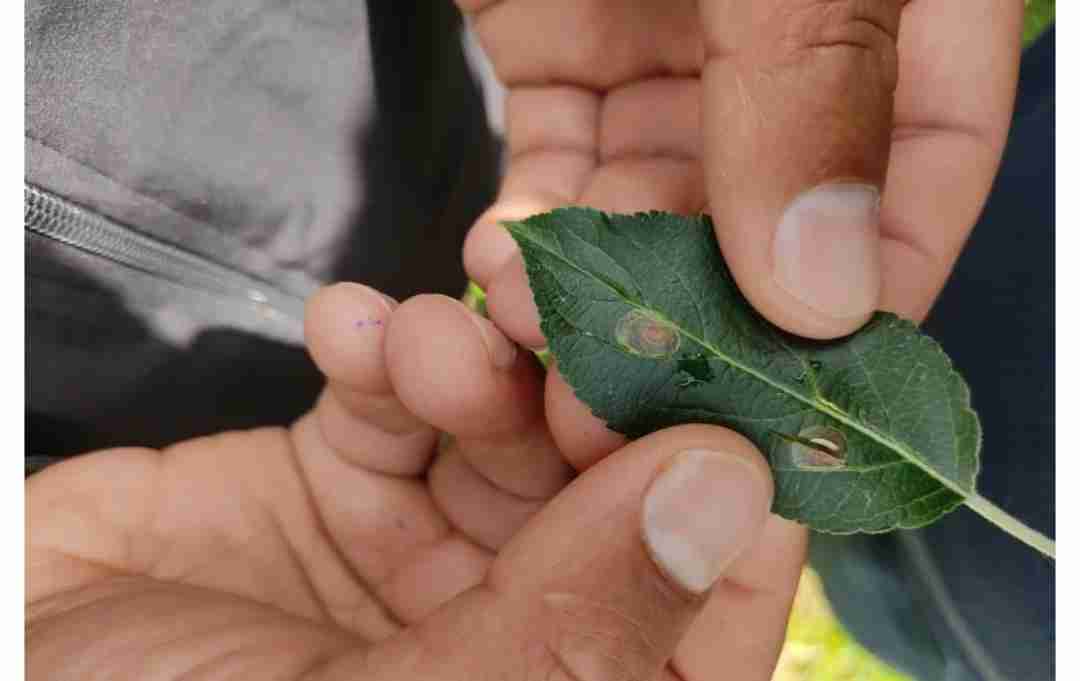
Inside the leaf, the larva feeds on the mesophyll cells, creating distinctive, serpentine, white-colored mines that gradually widen into large, blotch-like patches. These “blotches” are the tell-tale sign of an infestation. As the larva feeds, it damages the leaf’s ability to perform photosynthesis, the very process that gives the tree the energy to produce fruit and strengthen itself for the winter.
After completing its development inside the leaf, the larva exits, pupates, and the cycle repeats. In Kashmir’s climate, the pest can produce multiple generations in a single growing season, allowing its population to explode if left unchecked.
Why is it So Dangerous?
Dr. Sajad Mohiuddin, Professor-cum-Chief Scientist in the Division of Entomology, Faculty of Horticulture, SKUAST-K, provides a grave assessment.
“This pest is not indigenous to Kashmir and was first detected in the Shopian district a few years ago. Its foreign origin means our local ecosystem lacks natural predators to keep its population in check,” he explains. “The primary damage comes from premature leaf drop. A tree stripped of its leaves in late summer or early autumn cannot build sufficient carbohydrate reserves. This leads to weakened trees, poor flower bud formation for the next season, and reduced fruit size and quality. If left unmanaged for multiple seasons, it can lead to the eventual decline and death of the tree.”
The Critical Overwintering Phase: The Linchpin of Control
The most crucial insight from SKUAST experts, and the core of any successful apple blotch leaf miner control management plan, revolves around its overwintering behavior. As temperatures drop, the final generation of the pest does not die off; it strategically prepares to survive.
“The blotch leaf miner overwinters as a resilient pupal stage,” Dr. Mohiuddin states. “These pupae are not out in the open. They seek refuge in the fallen leaves, discarded ‘cull’ fruits, tree debris, under loose bark on the trunks and branches, and in the top layer of soil beneath the tree canopy. This is a survival masterstroke by the pest, using our orchard floor as its winter bunker.”
This biological fact makes the post-harvest period—after the apples have been picked but before the first heavy snowfall—the single most important window for intervention. “If not managed now, these pupae will remain protected from the winter cold. Come spring, as temperatures rise, they will emerge as adult moths in perfect sync with the new leaf flush. They will lay eggs, and the cycle will begin again with a massive head start, leading to rapid multiplication and far more severe damage than the previous year,” he adds.
The message is clear: a passive approach to winter will result in an active disaster in spring.
The SKUAST-Kashmir Post-Harvest Management Protocol: A Step-by-Step Guide for Apple Blotch Leaf Miner
A successful apple blotch leaf miner control management strategy is not a single action but a multi-pronged, integrated approach. The following steps, as outlined by SKUAST-Kashmir, must be followed meticulously.
- Complete Orchard Sanitation: The Foundation of Control
This is the most critical and effective non-chemical step. The goal is to eliminate the pest’s winter housing.
· Action: Immediately after leaf fall, conduct a thorough and meticulous collection of all fallen leaves, rotten fruits, and any other plant debris from the orchard floor.
· Destruction is Key: “These collected materials must be destroyed, not composted,” Dr. Mohiuddin insists. “A typical compost pile may not reach temperatures high enough to kill the pupae. You would simply be concentrating the pest and creating a future problem.” The recommended methods are burning or deep burial far away from the orchard area.
· Community Aspect: This should be a coordinated effort within a village or block. If one orchardist is diligent but his neighbor is not, the pest will easily recolonize the clean orchard the following spring.
- Deep Pruning and Canopy Management
Pruning serves a dual purpose: improving tree health and directly removing pests.
· Action: Perform deep pruning during the dormant season (late autumn to late winter). Focus on removing old, weak, unproductive, and visibly infested twigs and branches. Pay special attention to water sprouts and suckers, which are often heavily mined.
· Disposal: All pruned material must be viewed as contaminated. It should be gathered and destroyed outside the orchard, just like the leaf litter. Leaving pruned wood stacked in the orchard provides a perfect safe haven for the pest.
- Scraping Loose Bark
This is a often-overlooked but highly effective practice in an integrated management plan.
· Action: On a cool day, use a blunt but sturdy tool to gently scrape the loose, exfoliating bark from the trunks and main scaffold branches of the trees.
· Rationale: The space between the loose and tight bark is a preferred hiding spot for overwintering pupae. Scraping exposes them to harsh weather conditions, predators like birds, and any subsequent chemical sprays. Collect the scraped-off material and destroy it.
- Orchard Floor Management: Soil Cultivation
The soil beneath the tree is the final frontier for the pupae.
· Action: Conduct light ploughing or harrowing of the entire orchard floor. Pay particular attention to the “tree basin,” the area directly beneath the canopy where most debris falls.
· Rationale: This process physically disturbs the pupae in the soil, bringing them to the surface where they will be exposed to freezing temperatures, desiccation by wind and sun, and predation by birds and insects.
- Eliminating Alternate Hosts and Weeds
A clean orchard is a resilient orchard.
· Action: Remove all weeds and alternative host plants from the orchard and its immediate periphery.
· Rationale: Weeds and other plants can serve as alternative hosts for the leaf miner, allowing a reservoir of the pest to persist even if the apple trees are cleaned. Removing these hosts reduces the overall pest pressure.
Chemical Control: A Targeted Tool for Heavy Infestations
For orchards that have suffered significant defoliation during the season, cultural practices alone may not be sufficient to bring the pest under control. In such cases, a targeted chemical intervention is recommended.
Dr. Mohiuddin provides a specific recommendation: “In heavily infested areas, a post-harvest spray with Quinalphos 25 EC at a concentration of 100 ml per 100 litres of water is highly effective in controlling the overwintering pupal stage.”
Important Considerations for Chemical Control:
· Timing is Everything: This spray must be applied after harvest but before significant leaf fall, ensuring the chemical penetrates the orchard floor and tree surfaces where the pupae are settling in.
· Thorough Coverage: The spray must be applied thoroughly, drenching the tree trunks, branches, and the entire orchard floor to contact the hidden pupae.
· Safety First: Always wear personal protective equipment (PPE) including gloves, a mask, and goggles when handling and applying pesticides.
· Follow the Label: The pesticide label is the law. Adhere strictly to the recommended dosage, dilution, and safety instructions.
The Imperative of Collective Action: A Community-Wide Fight
Perhaps the most critical message from the experts is that pest control cannot be successful in isolation. The apple blotch leaf miner control management is a community endeavor.
“The control effort will only be effective if all farmers cooperate,” Dr. Mohiuddin warns with a tone of urgency. “This pest is mobile. The adult moth can fly from one orchard to another. Even if 90% of the orchardists in an area follow this advisory diligently, the 10% who do not will act as a reservoir, allowing the pest to multiply and spread back into the managed orchards. By next year, it could infest orchards across all districts if collective measures are not taken.”
This calls for a coordinated effort at the village level, supported by local horticulture departments and farmer producer organizations (FPOs).
Looking Ahead: A Call to Action for Kashmir’s Horticulture
The arrival and spread of the Apple Blotch Leaf Miner is a test for Kashmir’s horticulture sector. It challenges orchardists to move from reactive to proactive pest management. The old ways of dealing only with visible problems during the growing season are no longer sufficient.
The detailed advisory from SKUAST-Kashmir provides a clear, scientifically-backed roadmap. The path forward involves vigilance, hard work, and community spirit. Orchardists are not alone in this fight. The Department of Horticulture and the Krishi Vigyan Kendras (KVKs) in every district are equipped to provide guidance, demonstrations, and support.
The choice is clear: act now during this critical post-harvest window with a determined apple blotch leaf miner control management strategy, or face the consequences of a weakened, vulnerable orchard and a diminished harvest for years to come. The health of Kashmir’s iconic apple industry depends on the actions taken today.
For further guidance and demonstrations, orchardists are encouraged to contact their local Department of Horticulture office or the Krishi Vigyan Kendra (KVK) in their district.
step-by-step guide on how to implement the recommendations:
- Add a “Recommended Products” Section
Where to place it: After the “Chemical Control” section or as a separate box
Content to add:
Recommended Solutions for Apple Blotch Leaf Miner:
Chemical Control:
· Quinalphos 25 EC – 100 ml per 100 liters of water (as per SKUAST recommendation)
· Available at: Local horticulture departments, authorized pesticide dealers
Organic Alternatives:
· Neem Oil Spray – Ready-to-use organic solution
· Spinosad-based insecticides – Effective organic option
· Available at: Krishi Vigyan Kendras, certified organic stores
Where to Buy:
· Department of Horticulture offices in every district
· Krishi Vigyan Kendras (KVKs)
· Certified agricultural input dealers in Shopian, Baramulla, Pulwama
- Create a Dedicated Identification Section
Where to place it: Right after the initial introduction, before the biology section
Content to add:
How to Identify Apple Blotch Leaf Miner Damage: Key Symptoms
Look for these tell-tale signs in your orchard:
Silvery White Trails: Initial mining appears as thin, winding, white trails on leaves
Blotch Patches: Trails expand into large, irregular white or brown blotches
Black Specks: Tiny black fecal deposits visible inside the mined areas
Early Leaf Drop: Heavily infested leaves turn yellow and fall prematurely
Canopy Thinning: Severe infestations cause significant leaf loss, weakening the tree
Pro Tip: Hold leaves up to sunlight – the mines and larvae become clearly visible.
- Enhance the Life Cycle Section
Where to place it: In the “Understanding the Enemy” section
Content to add:
The Complete Life Cycle Breakdown:
- Egg Stage (3-7 days): Tiny white eggs laid on leaf undersides
- Larval Stage (10-15 days): Larvae mine inside leaves, creating damage
- Pupal Stage (Winter): Pupae hide in leaf litter, bark, and soil
- Adult Stage (Spring): Small white moths emerge to lay eggs
Critical Insight: The winter pupal stage is your BEST opportunity for control through sanitation measures.
- Integrate “People Also Search For” Terms
Throughout the article, naturally add these phrases:
· In the introduction: “This comprehensive leaf miner treatment guide specifically addresses Kashmir’s apple growing conditions…”
· In the biology section:
“Understanding the complete leaf miner life cycle is essential for timing your control measures effectively…”
· In the damage section: “Many orchardists first notice leaf miner damage when they see the characteristic white trails on leaves…”
· In the chemical section: “For severe infestations, the best pesticide for leaf miners in apples is Quinalphos 25 EC…”
· In the conclusion: “Proper leaf miner insecticide application combined with cultural controls provides the most effective management…”