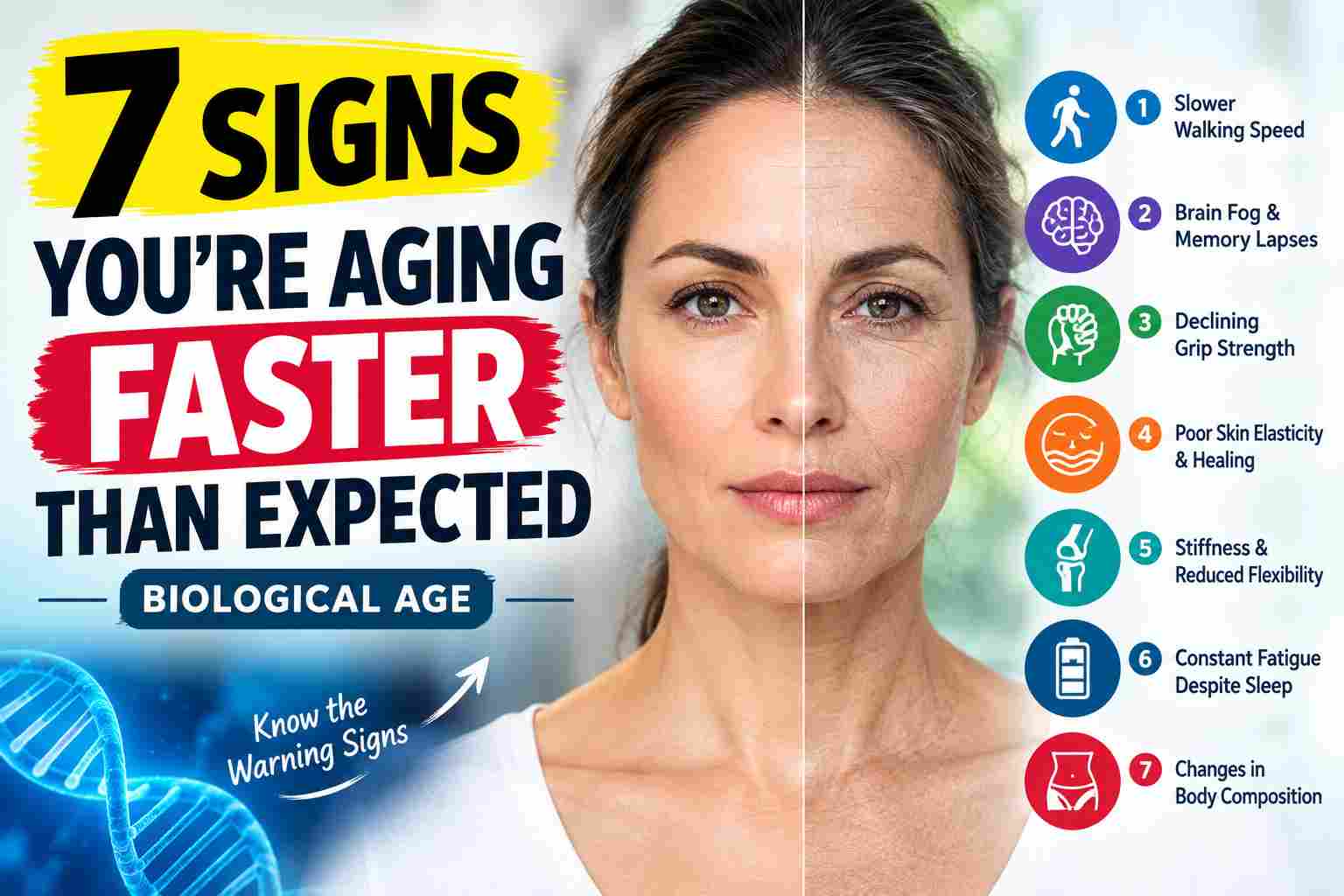
Signs Your Body May Be Aging Faster Than Expected: 7 Warning Signs
Your chronological age tells you how many years you have lived. Biological aging is more complicated: it refers to changes in the function and condition of cells, tissues and organ systems that occur over time.
Two people who are the same chronological age can have very different levels of muscle strength, cardiovascular fitness, metabolic health, cognitive function and physical independence.
10 signs of weak immune system: Warning Signs to Know
Scientists are studying ways to measure these differences using DNA-methylation clocks, blood biomarkers and physical-function measurements. The National Institute on Aging notes that there are now numerous molecular aging clocks, but researchers are still working to determine how accurately these measures reflect meaningful aspects of health and aging.
Some changes in your body may therefore be worth paying attention to. They do not automatically mean that you are aging prematurely, because many have other possible causes.
14 Signs of Vitamin D Deficiency: Symptoms, Foods & Recovery Time
How to Lose Belly Fat: A Science-Based Guide to a Slimmer, Healthier Waist
7 Warning Signs Your Body May Be Aging Faster Than Expected
Quick Takeaways
| Sign or measure | What it may reflect | What you can do |
|---|---|---|
| Slower walking speed | Mobility and physical function | Build strength, aerobic fitness and balance |
| Brain fog or memory changes | Sleep, stress, metabolic or cognitive health | Investigate persistent changes |
| Declining grip strength | Muscle strength and physical reserve | Add resistance training |
| Poor skin elasticity or slow healing | Skin aging or underlying health problems | Protect skin and investigate persistent wounds |
| Increasing stiffness | Mobility or joint problems | Maintain regular movement and strength |
| Persistent fatigue | Sleep or medical conditions | Look for the underlying cause |
| Changing body composition | Muscle loss and increasing fat mass | Prioritize strength, activity and nutrition |
1. Your Walking Speed Is Getting Slower
Walking speed is a simple measure of physical function. A noticeable decline can reflect changes in muscle strength, balance, cardiovascular fitness, coordination or overall mobility.
You may notice that:
- Your normal walking pace has slowed.
- Stairs have become harder.
- You need more breaks during routine activities.
- You feel less steady while walking.
- Activities that were previously easy now require more effort.
A slower gait does not prove accelerated biological aging. Arthritis, injuries, neurological problems, cardiovascular disease, inactivity and deconditioning can all affect walking ability.
However, declining mobility is worth taking seriously because maintaining physical function is an important part of healthy aging.
What can help?
Regular walking, resistance exercise and balance training can help maintain physical capacity. The appropriate level depends on your current fitness and health.
2. Persistent Brain Fog and Memory Lapses
Occasionally forgetting a name or misplacing an object is common.
Persistent changes are different.
Pay attention if you increasingly experience:
- Difficulty concentrating
- Mental fatigue
- Problems remembering recently learned information
- Trouble completing familiar tasks
- Frequently losing your train of thought
- A noticeable decline in your ability to work or function
These symptoms should not automatically be blamed on aging.
Poor sleep, chronic stress, depression, medications, alcohol use, nutritional problems, thyroid disorders and other medical conditions can affect memory and concentration.
Research on biological aging suggests that DNA-methylation measures can provide information associated with health outcomes, but they are not a substitute for a clinical cognitive evaluation.
When should you seek medical advice?
If memory or thinking problems are persistent, progressively worsening or interfering with everyday life, speak with a healthcare professional.
3. Your Grip Strength Is Declining
Grip strength is a surprisingly useful measure of physical function.
If you notice that opening jars, carrying shopping bags or lifting everyday objects is becoming increasingly difficult, it may indicate a decline in muscular strength.
Possible warning signs include:
- Difficulty opening containers
- Trouble carrying groceries
- Hands tiring quickly
- Difficulty lifting objects you previously handled easily
- General weakness accompanying declining grip strength
A healthcare or fitness professional can measure grip strength objectively using a hand dynamometer.
Why muscle matters
Maintaining muscle becomes increasingly important with age because muscle strength contributes to mobility, balance, independence and the ability to perform everyday activities.
Resistance training is one of the most effective ways to preserve strength.
The World Health Organization recommends muscle-strengthening activities involving major muscle groups on at least two days per week for adults.
4. Your Skin Is Losing Elasticity or Wounds Heal Slowly
Skin naturally changes with age.
Over time, structural proteins and the skin’s ability to retain moisture and repair damage can change. Sun exposure and smoking can also contribute to premature skin changes.
Possible signs include:
- Increasing dryness
- Reduced elasticity
- More visible wrinkles
- Thinner-looking skin
- Easy bruising
- Changes in skin texture
But slow wound healing deserves special attention.
Repeatedly slow-healing wounds can be associated with conditions such as diabetes, poor circulation, infection, nutritional problems or certain medications.
Therefore, slow healing should not simply be dismissed as “aging.”
If a wound is unusually slow to heal, repeatedly becomes infected or shows worsening redness, swelling or pain, seek medical advice.
5. You Are Becoming Increasingly Stiff or Less Flexible
Some loss of flexibility can occur with age, but increasing stiffness can also result from inactivity, previous injuries, osteoarthritis or other joint conditions.
You might notice:
- Difficulty bending down
- Trouble reaching overhead
- Stiffness after sitting
- Difficulty getting up from a chair
- Reduced range of motion
- Avoiding physical activities because movement has become difficult
Regular movement can help maintain mobility.
A balanced exercise routine can include:
- Walking
- Resistance training
- Mobility exercises
- Stretching
- Balance exercises when appropriate
If stiffness is severe, persistent, associated with swelling, or accompanied by significant pain, a medical evaluation may be appropriate.
6. You Feel Constantly Tired Despite Adequate Sleep
Persistent fatigue is one of the most common symptoms people associate with aging, but it has many possible explanations.
You may feel exhausted because of:
- Poor sleep quality
- Sleep apnea
- Iron deficiency or anemia
- Thyroid problems
- Depression or anxiety
- Chronic stress
- Certain medications
- Poor nutrition
- Diabetes or metabolic problems
- Other underlying medical conditions
Simply feeling tired does not establish that your mitochondria are aging prematurely.
If you consistently feel exhausted despite getting enough time in bed, the goal should be to identify the cause rather than assuming it is normal aging.
Don’t ignore sleep quality
For adults, the CDC recommends at least 7 hours of sleep per night, with needs varying by age.
If you snore loudly, gasp during sleep, stop breathing during sleep according to someone else, or experience severe daytime sleepiness, talk with a healthcare professional about possible sleep disorders.
7. Your Body Composition Is Changing
Aging can be accompanied by changes in body composition, including loss of muscle and increases in body fat.
You may notice:
- Increasing abdominal fat
- Declining muscle definition
- Reduced strength
- Difficulty performing physical activities
- Weight gain combined with reduced fitness
But body composition is influenced by many factors, including diet, physical activity, sleep, hormones, medications and genetics.
The goal should not simply be to make the number on the scale smaller.
Preserve muscle, not just body weight
Maintaining muscle strength and physical function is an important part of healthy aging.
Resistance training combined with adequate nutrition can help support lean muscle.
What Is Biological Age?
Chronological age is straightforward: it is the number of years since birth.
Biological age is an estimate of how old the body appears to be based on selected biological measurements.
The National Institute on Aging describes biological aging as an area of active research and notes that molecular aging clocks can use information such as DNA changes, protein expression and other biological data.
This means a person could theoretically have:
Chronological age: 50 years
Estimated biological age: different depending on the test used
But this does not mean that the person literally has the body of a different-aged person.
Different tests measure different aspects of aging.
How Is Biological Age Measured?
1. DNA-Methylation or Epigenetic Clocks
One of the best-known approaches examines DNA methylation.
DNA methylation involves chemical modifications that can influence gene regulation. Patterns of DNA methylation change as people age, allowing researchers to develop mathematical models called epigenetic clocks.
Some commonly discussed clocks include:
Horvath Clock
The Horvath clock is a DNA-methylation-based estimator originally designed to predict chronological age across multiple tissues.
PhenoAge
PhenoAge incorporates methylation information related to physiological aging and health outcomes.
GrimAge
GrimAge was developed to capture methylation patterns associated with mortality-related risk.
DunedinPACE
DunedinPACE takes a different approach.
Rather than simply estimating how old someone appears biologically, it estimates the pace of biological aging.
The original research found that DunedinPACE was associated with morbidity, disability and mortality in several datasets.
However, these tests remain research tools and should not be interpreted as definitive medical diagnoses.
2. Blood Tests
Routine blood tests do not provide a universally accepted “biological age.”
However, they can reveal health factors that are relevant to long-term aging.
Depending on your symptoms and risk factors, a clinician may consider tests such as:
| Category | Example | What it can assess |
|---|---|---|
| Blood sugar | HbA1c, glucose | Glucose control |
| Lipids | LDL-C, triglycerides, ApoB | Cardiovascular risk |
| Kidney | Creatinine, eGFR | Kidney function |
| Liver | ALT, AST, albumin | Liver-related health |
| Blood count | Hemoglobin, MCV, RDW | Anemia and blood-cell characteristics |
| Thyroid | TSH, free T4 when appropriate | Thyroid function |
| Inflammation | hs-CRP when clinically appropriate | Inflammatory activity |
The right tests depend on your health history and symptoms.
3. Physical and Functional Biomarkers
Some of the most useful measurements of healthy aging are not molecular at all.
They include:
Grip strength
Measures hand and forearm strength and can provide information about overall physical function.
Walking speed
Provides a simple measure of mobility and functional capacity.
Balance
Can help identify declining stability and fall risk.
VO₂ max
Measures the body’s ability to use oxygen during exercise and provides information about cardiorespiratory fitness.
Functional movement tests
Tests such as Timed Up and Go can provide information about mobility.
These measures are particularly valuable because they tell us about what the body can actually do.
Can You Reverse Biological Aging?
This is one of the most exciting—and misunderstood—areas of aging research.
Some clinical studies have reported changes in biological-age measurements after lifestyle or medical interventions.
But there is an important distinction:
Changing an aging biomarker is not the same thing as making a person younger.
A successful intervention ultimately needs to demonstrate meaningful improvements in health, function, disease risk or longevity—not simply a lower number on an aging clock.
The National Institute on Aging emphasizes that researchers are still working to validate biological-age measurements and determine how they can be used to test interventions that extend healthspan.
What Did the Fitzgerald Diet and Lifestyle Study Find?
A frequently discussed 2021 pilot randomized clinical trial led by Kara Fitzgerald investigated an eight-week diet and lifestyle intervention and measured DNA-methylation age.
The study reported a difference in Horvath DNAmAge between the intervention and control groups. The researchers described the results as evidence suggesting a potential reversal of epigenetic age.
However, this was a small pilot trial, and an erratum was subsequently published regarding the study.
A later case series involving only six women reported an average decrease in Horvath biological-age estimates after an eight-week diet and lifestyle program. Because this was a very small case series without a control group, the result cannot establish that the intervention reverses biological aging in the general population.
Therefore, headlines claiming that a specific diet can “make you years younger” go beyond what these studies prove.
What Did the CALERIE Study Find?
The CALERIE trial provides stronger evidence because it was a randomized controlled trial involving adults without obesity.
In a post-hoc analysis of 220 participants, researchers found that calorie restriction slowed aging as measured by DunedinPACE.
However, the intervention did not significantly change several other DNA-methylation clocks, including PhenoAge and GrimAge, and the reported effects were relatively small. The researchers also noted that longer-term trials are needed to determine whether such biomarker changes translate into meaningful improvements in chronic disease or mortality.
This is an important lesson:
One biological-aging measurement can change without every aging measurement changing.
Can Exercise Slow Biological Aging?
Exercise has much stronger evidence for improving physical health than any specific “anti-aging” supplement.
Regular physical activity supports cardiovascular fitness, muscle strength, mobility and metabolic health.
The WHO recommends that adults perform at least:
- 150 minutes of moderate aerobic activity per week, or
- 75 minutes of vigorous activity per week, or an equivalent combination
Adults should also perform muscle-strengthening activities involving major muscle groups on two or more days per week.
For older adults with poor mobility, WHO also recommends activities that improve balance and help prevent falls.
You don’t need an extreme exercise program.
Consistency matters more.
Can Diet Support Healthy Aging?
There is no single food that can stop aging.
Instead, focus on an overall dietary pattern containing:
- Vegetables
- Fruits
- Beans and lentils
- Whole grains
- Nuts and seeds
- Healthy fats
- Adequate protein
- Fish or other nutritious protein sources
- Minimally processed foods
At the same time, limit excessive intake of highly processed foods, added sugars and other foods that make it difficult to maintain a healthy overall diet.
The goal is not to follow a complicated “longevity protocol.”
It is to establish eating habits that support cardiovascular health, metabolic health, muscle maintenance and a healthy body composition over many years.
What About a 12-Hour Overnight Fast?
Time-restricted eating is being studied for metabolic health and aging.
A simple overnight eating break—for example, finishing dinner at 7 p.m. and eating breakfast at 7 a.m.—may be reasonable for some healthy adults.
However, there is not enough evidence to say that a 12-hour fast will reliably reduce someone’s biological age by a specific number of years.
People with diabetes, eating disorders, pregnancy, certain medical conditions or medications that affect blood glucose should seek individualized medical advice before intentionally restricting eating times.
What About Stress?
Chronic stress can affect sleep, physical activity, eating behavior and overall health.
There is also emerging research suggesting that some stress-related changes in biological-age measurements may be reversible when the stressor resolves. An NIA-highlighted study found that biological-age measures increased during several forms of physiological stress and decreased after recovery.
This is promising, but it does not mean that meditation or breathing exercises can reliably “reverse your biological age.”
Practical stress-management strategies include:
- Regular physical activity
- Adequate sleep
- Relaxation exercises
- Time outdoors
- Social connection
- Hobbies
- Professional mental-health support when needed
Should You Take Metformin, Growth Hormone or DHEA for Anti-Aging?
No—not simply because you want to slow aging.
These are biologically active substances and should not be treated as ordinary longevity supplements.
An early small study involving growth hormone, DHEA and metformin generated interest because researchers reported changes in thymic function and epigenetic-age measures. But the study was preliminary and raised important questions about whether changes in DNA-methylation clocks represent genuine reversal of aging-related physical function.
More recent research continues to test metformin in specific populations, and results have not established it as a general anti-aging medication. A 2026 randomized pilot trial in older adults with HIV found no significant difference in its primary epigenetic-age outcome between metformin and placebo, illustrating why larger trials are needed.
Do not take prescription medicines for longevity without medical supervision.
What About Anti-Aging Supplements?
Compounds such as curcumin, EGCG, resveratrol, alpha-ketoglutarate and NAD-related products are frequently promoted as longevity interventions.
Some have interesting laboratory or early human research behind them.
But evidence that any particular supplement can reliably make healthy humans biologically younger or extend lifespan remains insufficient.
A lower biological-age number on one laboratory test should not automatically be interpreted as proof that a supplement improves healthspan.
How to Support Healthy Aging: The Evidence-Based Basics
You don’t need an expensive biological-age test to begin improving your health.
1. Build and maintain muscle
Perform resistance exercises involving the major muscle groups at least twice per week when appropriate.
2. Stay aerobically active
Work toward at least 150 minutes of moderate activity each week, or the equivalent amount of vigorous exercise.
3. Protect your sleep
Most adults need at least seven hours of sleep each night, although individual needs vary.
4. Eat mostly nutrient-dense foods
Prioritize vegetables, fruits, legumes, whole grains, healthy fats and adequate protein.
5. Don’t smoke
Avoiding tobacco is one of the most important things you can do for long-term health.
6. Maintain a healthy body composition
Focus on preserving muscle and physical function rather than simply chasing a lower scale weight.
7. Address medical problems early
Control conditions such as high blood pressure, diabetes and abnormal cholesterol according to your clinician’s recommendations.
When Should You See a Doctor?
Don’t assume that new physical or mental changes are simply signs of getting older.
Seek medical advice for:
- Persistent unexplained fatigue
- Significant or rapidly worsening weakness
- Unintentional weight loss
- Persistent memory problems
- New balance problems
- Slow-healing wounds
- Persistent shortness of breath
- Major changes in exercise tolerance
- Severe or worsening stiffness
- Significant changes in body composition
Many problems that resemble “accelerated aging” have identifiable causes and may be treatable.
Frequently Asked Questions
What is biological age?
Biological age is an estimate intended to describe aspects of physiological or molecular aging. It can be estimated using DNA methylation, blood biomarkers, physical-function measurements and other approaches. There is no single universally accepted biological-age test.
What is DunedinPACE?
DunedinPACE is a DNA-methylation-based measure designed to estimate the pace at which biological aging is occurring. Research has associated higher values with several adverse health outcomes, but it is not a definitive clinical diagnosis.
Can exercise lower biological age?
Exercise improves many established measures of health, including physical fitness, muscle strength and cardiovascular health. Some research also suggests exercise may influence biological-aging biomarkers, but it is premature to promise a specific reduction in biological age.
Can diet reverse biological aging?
Some small studies have reported changes in epigenetic-age measurements after dietary and lifestyle interventions. However, the evidence is still preliminary, and a change in an epigenetic clock does not necessarily mean that a person has become biologically younger.
Is a biological-age test worth taking?
It depends on why you want one. These tests can be interesting for research or personal tracking, but they should not replace routine medical care, established health measurements or professional evaluation of symptoms.
What is the best way to slow aging?
There is no proven single anti-aging treatment. Regular physical activity, strength training, adequate sleep, nutritious food, avoiding tobacco and managing important medical risk factors have substantially stronger foundations than unproven longevity products.
Bottom Line
Your chronological age is only one part of the aging story.
Changes such as slower walking, declining grip strength, persistent cognitive problems, reduced flexibility, chronic fatigue, skin changes and unfavorable body-composition changes can signal that your physical health deserves closer attention—but none of these signs alone proves that you are aging faster than expected.
Modern biological-age research is opening new possibilities for understanding aging. DNA-methylation clocks such as Horvath, PhenoAge, GrimAge and DunedinPACE can provide valuable research information, but they are still being evaluated and should not be treated as definitive measures of how many years you have left to live.
The most practical strategy remains simple:
Preserve muscle. Keep moving. Eat well. Sleep adequately. Avoid tobacco. Manage chronic health conditions. Reduce unnecessary stress. And investigate persistent symptoms instead of assuming they are simply part of getting older.
Healthy aging is ultimately less about making a laboratory number younger and more about preserving your ability to move, think, recover and remain independent for as long as possible.
Medical Disclaimer
This article provides general health information and is not intended to diagnose, treat, cure or prevent any disease. Biological-age tests are estimates and should not be used on their own to make medical decisions. Always discuss persistent symptoms, abnormal test results, medications or supplements with a qualified healthcare professional.
Medical disclaimer: This article is for general educational purposes and does not diagnose biological aging or replace medical advice. Persistent, sudden, or unexplained symptoms should be evaluated by a qualified healthcare professional.