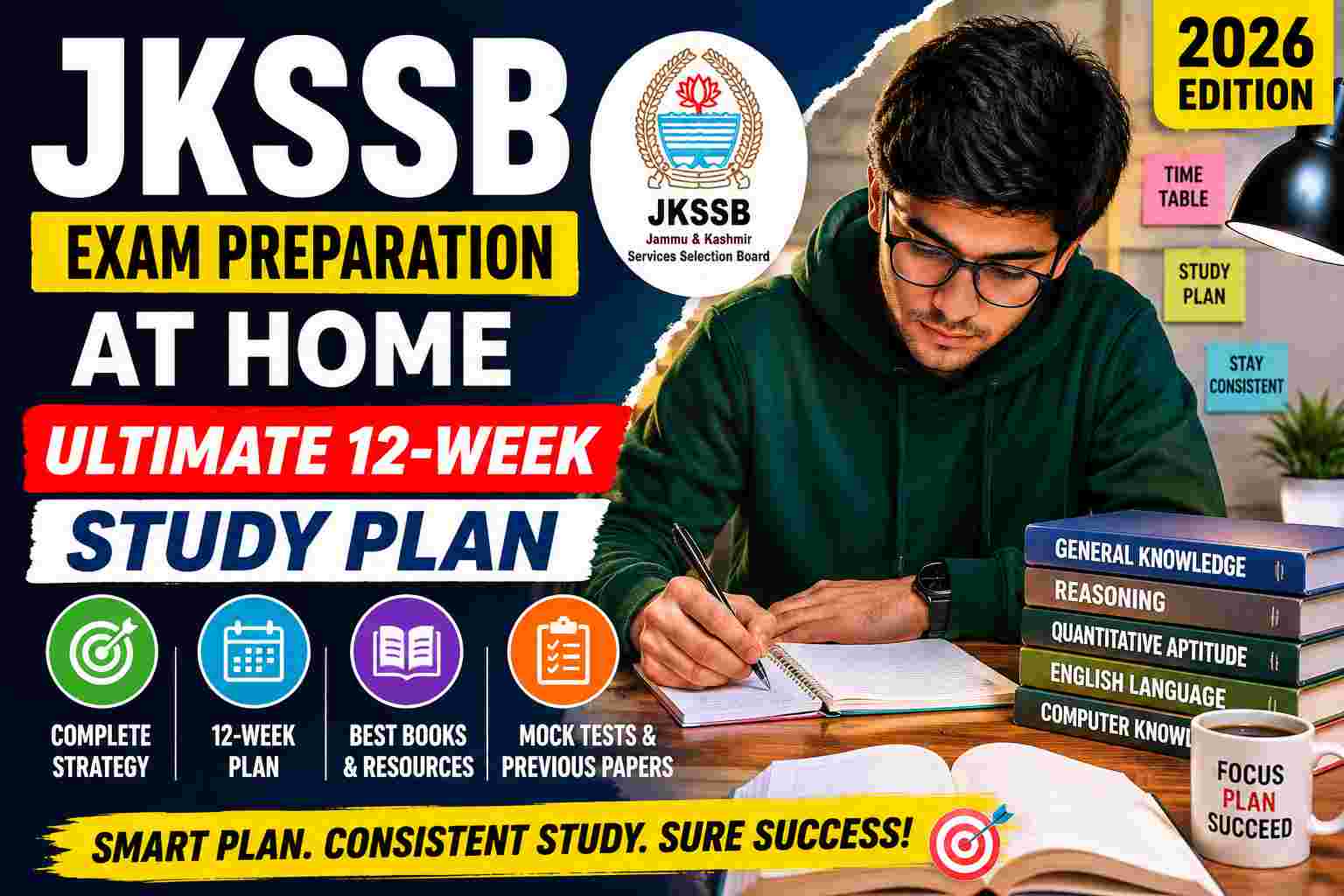
JKSSB Exam Preparation at Home — Ultimate 12-Week Study Plan.
Preparing for Jammu & Kashmir Services Selection Board (JKSSB) exams from home is entirely possible with the right strategy, discipline, and resources. Whether you’re aiming for clerical, technical, or administrative posts, this guide provides a step-by-step, actionable plan to study effectively at home, improve knowledge and exam skills, and achieve high scores. The article covers cognitive strategies, subject-specific techniques, weekly and monthly schedules, resources (books, websites, apps), mock test strategies, time management, mental fitness, and exam-day tactics.
Why Home Preparation Works for JKSSB
- Flexibility: Customize study hours to match your energy and commitments.
- Cost-effective: Save on coaching fees and travel.
- Focused learning: Build a tailored study plan to target weak areas.
- Self-paced: Pause, revise and repeat sections until mastery.
Primary Components of JKSSB Exam Preparation
- Syllabus Analysis
- Structured Study Plan
- Quality Study Materials
- Regular Practice & Mock Tests
- Revision and Time Management
- Health and Motivation
Step 1 — Analyze the JKSSB Syllabus & Exam Pattern
- Download the official JKSSB notification and syllabus for your specific post.
- Identify paper sections: General Knowledge, Current Affairs, General Science, Mathematics, Reasoning, Computer Knowledge, English Language, and Subject-specific portions (e.g., nursing, engineering).
- Note: Many JKSSB exams have two stages: Objective Written Test (Computer Based Test) and Skill/Interview stages.
Action: - Create a master syllabus document listing topics under each section.
- Assign weightage to topics by reviewing past papers and official cutoffs.
Step 2 — Set Clear, Measurable Goals
- Define target score, exam date, and milestones (monthly, weekly).
- Use SMART goals: Specific, Measurable, Achievable, Relevant, Time-bound.
Example: - “Score 80% in objective practice tests within 3 months” or “Complete full NCERT coverage for science and history in 6 weeks.”
Designing a 12-Week Study Plan (Sample Framework)
This sample plan assumes a baseline of 3–6 months’ preparation depending on exam date. Adjust according to remaining time.
Weeks 1–2: Foundation & Syllabus Coverage
- Day 1–3: Syllabus breakdown and resource collection.
- Day 4–14: Basics of General English (grammar + comprehension), Mathematics fundamentals (arithmetic and algebra basics), and General Knowledge (history + geography basics).
- Daily: 1 hour current affairs, 1 hour reading core subject.
Weeks 3–6: Build Core Competence
- Focus: Complete NCERT/classic texts for basic science, polity, economy, and mathematics practice.
- Start daily 1-hour reasoning practice and 1-hour computer basics.
- Weekend: Full-length practice test (timed) and detailed review.
Weeks 7–10: Intensify Practice & Topic Mastery
- Focus on tougher topics, e.g., data interpretation, reasoning puzzles, applied mathematics.
- Increase mock tests to 2 per week, analyze mistakes thoroughly.
- Revise older topics in 30-minute daily “flash revision” sessions.
Weeks 11–12: Revision & Mock Exam Sprint
- Daily: 1 full mock + 2 sectional timed tests; afternoon focused revision of weak topics.
- Last 2–3 days before exam: light revision, rest, and mental preparation.
Daily Time Allocation (If studying full-time)
- Morning (2–3 hours): Core subject study (maths/science) — high-intensity cognitive tasks.
- Midday (1 hour): Current affairs and GK reading.
- Afternoon (2 hours): English, reasoning, and computer aptitude.
- Evening (1–2 hours): Practice tests, revision, and solved papers.
- Night (30–45 minutes): Light reading, flashcards, and relaxation.
If Part-Time (Working Candidates)
- Early morning (1 hour): Vocabulary & current affairs.
- Breaks/lunch (30–45 min): Short quizzes or flashcards.
- Evening (2 hours): Subject deep dive + mock practice.
- Weekend: 6–8 hours for full tests and revision.
Subject-Wise Preparation Strategies
General Knowledge & Current Affairs
- Use a monthly current affairs compilation (newspapers + reliable magazines).
- Read one national daily (The Hindu/Indian Express) or use trusted daily digest apps.
- Focus areas: Jammu & Kashmir local news, national polity, economy, awards, sports, science, and government schemes.
- Create flashcards for dates, names, schemes, and statistics.
- Weekly action: Summarize top 20 news items in one page.
General Science
- Start with NCERTs (Class 6–10 basic science, Class 11–12 fundamentals as needed).
- Build concept notes: one-page summaries for each major topic.
- Emphasize practical concepts and applications tested in objective questions.
- Practice previous year questions and topic-wise MCQs.
Mathematics & Numerical Ability
- Master basics: number systems, ratios, percentages, profit-loss, time-speed-distance, time & work, algebra basics, geometry, and simple interest.
- Use short tricks for speed: Vedic math shortcuts, approximation techniques, and elimination strategies.
- Regular timed practice on problem sets and sectional tests.
- Keep a “formula bank” document (practice writing from memory).
Reasoning & Mental Ability
- Cover: verbal reasoning, non-verbal reasoning, puzzles, syllogism, inequalities, coding-decoding, seating arrangement.
- Solve at least 10–20 puzzles daily, increase complexity gradually.
- Learn pattern recognition techniques and diagrammatic shortcuts.
Computer Knowledge
- Basic hardware & software terms, MS Office (Word, Excel, PowerPoint), internet basics, networking and database fundamentals.
- Practice typing and Excel shortcuts because objective test questions may expect practical knowledge.
English Language
- Focus on grammar (tenses, subject-verb agreement), reading comprehension, synonyms/antonyms, error spotting, and sentence rearrangement.
- Read editorials and practice comprehension passages.
- Build vocabulary via 5–10 new words daily and revise with spaced repetition.
Subject-Specific Technical Knowledge
- For technical posts (engineering, medical, IT): follow standard textbooks, previous years’ papers, and post-specific guidelines.
- Make concise formula sheets and troubleshooting guides for practical topics.
Resource List (Recommended Books & Tools)
- NCERT textbooks (6–12) — basics for GK and Science.
- Lucent’s General Knowledge / Lucent’s Reasoning.
- R.S. Aggarwal for quantitative aptitude and reasoning (selective chapters).
- Arihant GK / Manorama Yearbook for current affairs summary.
- Previous year JKSSB question papers (download from official site).
- Online portals: Unacademy (free content), YouTube channels for topic videos, Testbook / Gradeup for mock tests.
- Mobile apps: Adda247, Jagran Josh, Daily Current Affairs apps.
- Tools: Anki (flashcards), Google Calendar (study schedule), Pomodoro timer.
Mock Tests & Practice Strategy
- Start with topic-wise MCQs, progress to sectional tests, then full-length mocks.
- Simulate exam conditions: timed tests, limited breaks, no external help.
- After each test, perform error analysis:
- Categorize mistakes: Careless, conceptual, time-pressure, or misreading.
- Maintain an error log with solutions and revision notes.
- Aim to increase test difficulty and decrease time per question over weeks.
Revision Techniques
- Spaced repetition: revisit topics after 1 day, 3 days, 7 days, and then monthly.
- Active recall: write answers from memory rather than re-reading.
- Use mind maps for history and polity timelines.
- One-page summaries for each major topic to review before exams.
- Weekly quick-charts: GK facts, important dates, formulas.
Time Management & Productivity Tips
- Use Pomodoro technique: 25–50 minutes study + 5–10 minutes break.
- Prioritize high-weightage topics and weak areas.
- Avoid multitasking—single-task with full focus.
- Block distracting websites/apps during study using tools (e.g., Forest, Cold Turkey).
- Keep a study journal to track progress, mood, and adjustments.
Motivation & Mental Health
- Set short wins: finish a chapter, improve mock score by 5%, or clear 30 puzzles.
- Maintain work-life balance: regular exercise, sleep (7–8 hours), and healthy diet.
- Practice mindfulness or breathing exercises for anxiety.
- Connect with peer groups for doubt solving and motivation; limit social media.
Exam-Day Strategy
- Prepare documents, admit card, ID proof, and stationary a day before.
- Reach exam center early; avoid last-minute rush.
- Read instructions carefully; allot time per section before starting.
- Attempt easy questions first to build confidence and secure marks.
- Don’t get stuck—mark tough questions for review and move on.
- Maintain calm; use deep-breathing if stressed.
Common Mistakes to Avoid
- Over-relying on coaching or multiple resources — pick a few reliable ones.
- Ignoring previous years’ questions.
- Neglecting mock tests and error analysis.
- Cramming last week instead of revision and practice.
- Inconsistent routine — build habit with micro-goals.
Tracking Progress: KPIs to Monitor
- Weekly: topics completed, mock test scores, accuracy percentage, time per question.
- Monthly: improvement in sectional scores, number of past papers completed.
- Pre-exam: consistent mock scores above expected cutoff + comfort with time management.
Sample 8-Week Intensive Plan (For Near-term Exams)
Week 1: Cover basics—English grammar, arithmetic fundamentals, current affairs.
Week 2: Reasoning basics, basic general science, start mock tests once a week.
Week 3: Subject-specific topics, increase tests to 2/week, daily GK flashcards.
Week 4: Focus on weak areas, timed practice, mock test analysis.
Week 5: Full syllabus revision start, increase vocabulary and comprehension practice.
Week 6: Two full mock tests per week; heavy error correction.
Week 7: Rapid revision using one-page notes, practice last year papers.
Week 8: Light revision, rest, and simulation of exam-day conditions.
Using Technology Effectively
- E-books and PDFs for quick access to materials.
- Video lectures for conceptual clarity (use 1–1.5x speed if comfortable).
- Online test series for real-time analytics and performance graphs.
- Use calendar and reminders for consistent study and deadlines.
How to Use Previous Year Papers
- First read: understand question pattern and difficulty level.
- Second pass: solve under timed conditions.
- Third pass: analyze, create error log, and identify recurring topics.
- Note frequency of questions on specific topics and focus revision accordingly.
Scoring & Cutoff Insights
- Check official JKSSB cutoff trends for the last 3–5 years for your category and post.
- Aim 10–15% above expected cutoff to secure margin for negative marking and tie-breaks.
- Prioritize accuracy over attempting too many questions.
Interview & Document Stage (If Applicable)
- Prepare a concise self-introduction and common interview questions about your education, experience, and motivation.
- Keep scanned copies of required documents, certificates, and caste/reservation papers ready.
- Dress professionally, maintain polite and confident posture.
Sample Study Day (Detailed)
- 06:00–06:30: Morning walk + light journal
- 06:30–07:30: Vocabulary + current affairs (reading + flashcards)
- 08:00–10:00: Mathematics (concepts + problem sets)
- 10:30–12:00: Subject-specific chapter (e.g., GK history)
- 13:00–14:00: Break + lunch + short rest
- 14:00–16:00: Reasoning exercises + puzzles
- 16:30–17:30: Computer basics / English grammar
- 18:00–19:30: Mock test or practice set
- 20:00–21:00: Review errors + light revision + plan next day
FAQs (Quick Answers)
Q: How many hours per day are enough?
A: 4–6 focused hours for part-time aspirants; 8–10 for full-time. Consistency beats long irregular hours.
Q: Which GK sources are best for JKSSB?
A: NCERTs for basics, Lucent for quick facts, Manorama/Pratiyogita Darpan for current affairs, and local JK news portals for state-specific content.
Q: How to manage negative marking?
A: Prioritize accuracy: attempt high-confidence questions first, avoid guessing unless partial elimination yields >50% chance.
Q: Is coaching necessary?
A: No. Many candidates clear JKSSB with disciplined self-study. Coaching helps for structure and doubt clearing but is optional.
Q: How to improve speed in objective tests?
A: Timed practice, shortcuts, pattern recognition, and repeated mock tests reduce time per question.
Action Checklist (Next 7 Days)
- Download latest JKSSB notification and syllabus.
- Collect 2–3 core resources (NCERT + one GK book + one aptitude book).
- Prepare a weekly timetable and start Day 1 topics.
- Start daily current affairs habit and flashcards.
- Solve one previous year paper to establish baseline.
- Join one test series or plan weekly mock tests.
- Build an error log template for continuous improvement.
Closing Notes
Preparing for JKSSB exams at home demands discipline, planning, and continuous practice. Use the strategies above—syllabus mastery, structured study plan, subject-focused techniques, mock tests, and mental fitness—to build momentum and confidence. Keep adapting the plan based on mock-test feedback, and stay consistent.